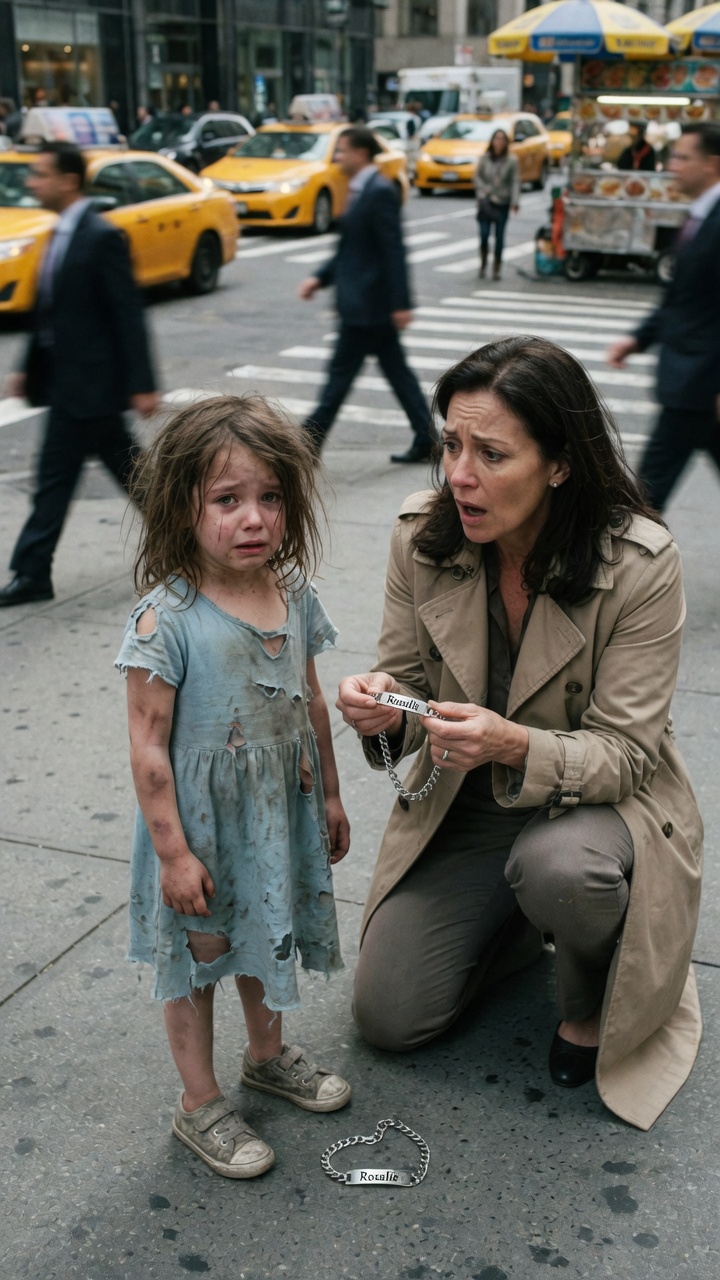
This Silver Bracelet begins on a Manhattan sidewalk where speed had become the city’s first language and mercy often arrived too late. Taxis cut across the avenue, pedestrians rushed around food carts, and no one slowed down long enough to notice the little girl standing alone near the curb. She looked too small for the noise around her and too frightened to ask for help in a place that barely noticed adults, let alone a child. Her dress was torn. Her arms were bruised. Her face was streaked with dirt and tears. Then, in the middle of all that motion, a silver bracelet slipped from her wrist and struck the pavement with a tiny metallic sound that changed the direction of a family’s life. Clara Vance heard that sound, looked down, and picked up the bracelet without knowing that she was holding the first answer to a five-year nightmare.
Part 1: The Silver Bracelet on the Sidewalk
The little girl kept walking. She did not notice the bracelet had fallen. She did not notice that Clara had stopped. She only kept crying as if she were searching for a person the crowd had erased. Clara had been heading toward an important meeting, her mind full of deadlines and obligations, but something about the child made the day feel suddenly smaller and less important. The girl’s hands shook. Her breathing came in short, broken waves. She looked like someone who had already spent too much time afraid.
Clara hurried after her and crouched beside her with the bracelet held out gently. “Sweetheart, is this yours?” she asked.
The child turned, and the moment she saw the bracelet in Clara’s hand, her face collapsed in fresh grief. “It’s my mommy’s,” she sobbed.
Clara’s pulse changed at once. The answer carried more weight than a lost accessory should have carried. It sounded personal. It sounded impossible. She asked where her mother was, and the girl only shook her head. “I don’t know,” she whispered. “I can’t find her.”
Her name was Emily. She was five years old. That was all she could say with any certainty. Clara noticed the bruises on her arms and the dirt on her knees. She also noticed the way Emily kept looking over her shoulder, as if she expected someone dangerous to step out of the crowd and take her away again. Clara pulled her close, trying to keep her calm, and looked at the bracelet one more time.
It was old silver, worn smooth by years of being touched and worn. The chain was delicate, but the charm was heavy. Clara turned it over in her palm. One engraved name appeared inside the metal.
Rosalie.
The air seemed to leave the street.
Rosalie was Clara’s sister. Rosalie had vanished five years earlier. On the same night, her newborn daughter had disappeared from the crib beside her bed. The police had searched. Private investigators had followed leads across boroughs and states. The family had spent money, time, and hope trying to find answers. Nothing had come back. No body. No witness. No clear suspect. Only silence, and one missing bracelet that had once belonged to Rosalie herself.
Clara looked at the child again, and the world in her mind began to tilt. The girl’s eyes were bright green, almost startlingly familiar. Clara had seen that same color in Rosalie’s eyes a thousand times growing up, in family photographs, and in the mirror when Rosalie laughed. Clara felt her knees weaken. She touched the girl’s cheek with trembling fingers and asked, “How old are you?”
“Five,” Emily said.
Five years. Clara felt the number settle into place with a force that made her breathe differently. Emily’s age matched the timing of Rosalie’s disappearance. The bracelet matched the last object the family had ever seen from that night. The eyes matched too closely to ignore. Clara held the child harder, not wanting to frighten her, but unable to stop the certainty rising inside her chest.
People on the sidewalk finally started to look. A few slowed down. Some stared. Others kept walking, pretending not to see what was happening. Clara did not care. She hugged Emily as if the child might vanish if she loosened her grip. “I’m crying because I’ve been looking for you for five years,” she told her, and the words sounded as if they had been waiting that entire time to be spoken.
Emily frowned and asked, “You know me?”
Clara closed her eyes, trying to steady herself. Then she whispered the truth. “I’m your aunt.”
The little girl froze. Somewhere in the city, a siren passed. A taxi horn blared. Someone shouted into a phone. None of it mattered. The only thing Clara could hear now was the sound of her own heart, racing toward a truth she had not expected to find on a sidewalk in Manhattan.
And just as she stood there holding the child and the bracelet, her phone began to ring.
The name on the screen made her stomach turn: Detective Harris, the officer who had worked Rosalie’s original missing-person case.
Clara answered with a voice that barely sounded like her own, and whatever the detective said made her body go still. He had news. He had a lead. He needed her to come in immediately. The case that had stayed cold for five years was moving again, and Clara was holding the one clue that had dragged it back to life.
She looked down at Emily, who had not yet understood the full shape of what was happening, only that this woman was crying for her and had not let go. Clara tucked the bracelet into her hand and promised she was not going anywhere. Then she made the call that would bring police, memory, and danger into the same story again.
Part 2: The Nightmare the Bracelet Uncovered
The first officers arrived within minutes. Clara repeated the engraved name, Rosalie, again and again, as if saying it enough times would make the past easier to accept. Emily stayed close, one small hand wrapped around Clara’s coat sleeve. A paramedic checked the child for immediate injuries while a second officer called child services and requested backup from the missing-persons unit. Soon the sidewalk that had ignored Emily was filled with people who suddenly understood that something far bigger than a lost child was unfolding in front of them.
When Detective Harris arrived, he did not waste a second. He saw the bracelet, heard the name, and changed direction immediately. He had spent years on Rosalie’s case and remembered every dead end, every false claim, every thread that had broken apart in his hands. The bracelet made him different. It was not a rumor. It was not a guess. It was physical proof that connected the child standing in front of him to the woman who had vanished five years before.
Clara’s voice shook as she explained everything she had seen. The little girl. The bruises. The bracelet. The engraved name. Emily’s age. The detective listened without interrupting. Then he asked the question Clara had already begun to fear: where had Emily been before that sidewalk?
The answer did not come from Emily. It came later, from a search that unfolded in real time. By tracing the bracelet, by checking old storage records, by reopening a set of sealed complaints, detectives followed a trail toward a rented apartment in Queens. There they found the first real evidence that Rosalie had survived the night she disappeared. She had been kept under a false name. Her movements had been controlled. Her contact with the outside world had been tightly restricted. Years of fear had shaped her life into something almost unrecognizable.
The man responsible had convinced her no one was looking. He had fed her lies until every day became a question of endurance. But Emily had grown old enough to sense danger. She had watched the locks. She had seen the fear in her mother’s face. She had also seen the bracelet, kept safe because Rosalie believed it might still matter someday. In the end, the child was the one who escaped first, running through Manhattan with the bracelet hidden until it slipped off on the sidewalk and landed at Clara’s feet.
Rosalie was found alive later that night. Clara did not see her at first because she was still holding Emily in a hospital waiting room, helping her drink water and keeping her warm under a blanket. When the doors opened and Rosalie entered with police beside her, Clara forgot how to stand. Her sister looked thinner, older, and exhausted by years no one should have had to survive. But her eyes were unmistakable. When Emily saw her mother, the child let out one broken cry and ran.
Rosalie fell to her knees and caught her daughter in her arms before she hit the floor. They held each other so tightly that Clara had to turn away for a second because the sight hurt too much to keep staring at. No one in that room said much. There was nothing elegant to say about five stolen years. There was only breathing, crying, and the sound of a family piecing itself back together in fragments.
The police later confirmed the entire truth. Rosalie had been abducted and hidden under a false identity. Her daughter had been kept with her. The bracelet had remained one of the only real pieces of her old life, and she had held onto it because she believed someone in her family might still recognize it if it ever surfaced again. That belief had been enough. It had guided Emily to freedom and led Clara straight to the truth.
The arrest that followed closed one chapter and opened another. The case against the man who had controlled Rosalie for years was strong enough to make sure he would not disappear again. The family learned that the nightmare had not been simple, and the road ahead would not be either. There would be trauma, hearings, therapy, paperwork, and many quiet moments of grief for the years they could never recover.
But there would also be mornings with breakfast shared at the same table. There would be school forms, doctor visits, and the ordinary noise of a home being rebuilt. Clara helped with all of it. She made calls. She found housing. She sat with Emily when the little girl woke up from nightmares. She stayed with Rosalie through the slow, painful process of relearning what safety felt like.
Months later, the silver bracelet sat inside a velvet box on a shelf in Rosalie’s home. It was no longer a lost clue. It was proof. Proof that one child’s cry on a crowded street could still break through years of silence. Proof that family bonds can survive even after long seasons of darkness. And proof that sometimes the smallest object in the world carries the heaviest truth.
Emily still asked questions. Rosalie still cried at unexpected times. Clara still remembered the exact sound of the bracelet touching the pavement. But now that sound meant something different. It was no longer the sound of a missing child. It was the sound of a family finding its way back.
Sometimes a single act of attention can change everything, and sometimes the truth arrives quietly, in the form of a silver bracelet on a Manhattan sidewalk.