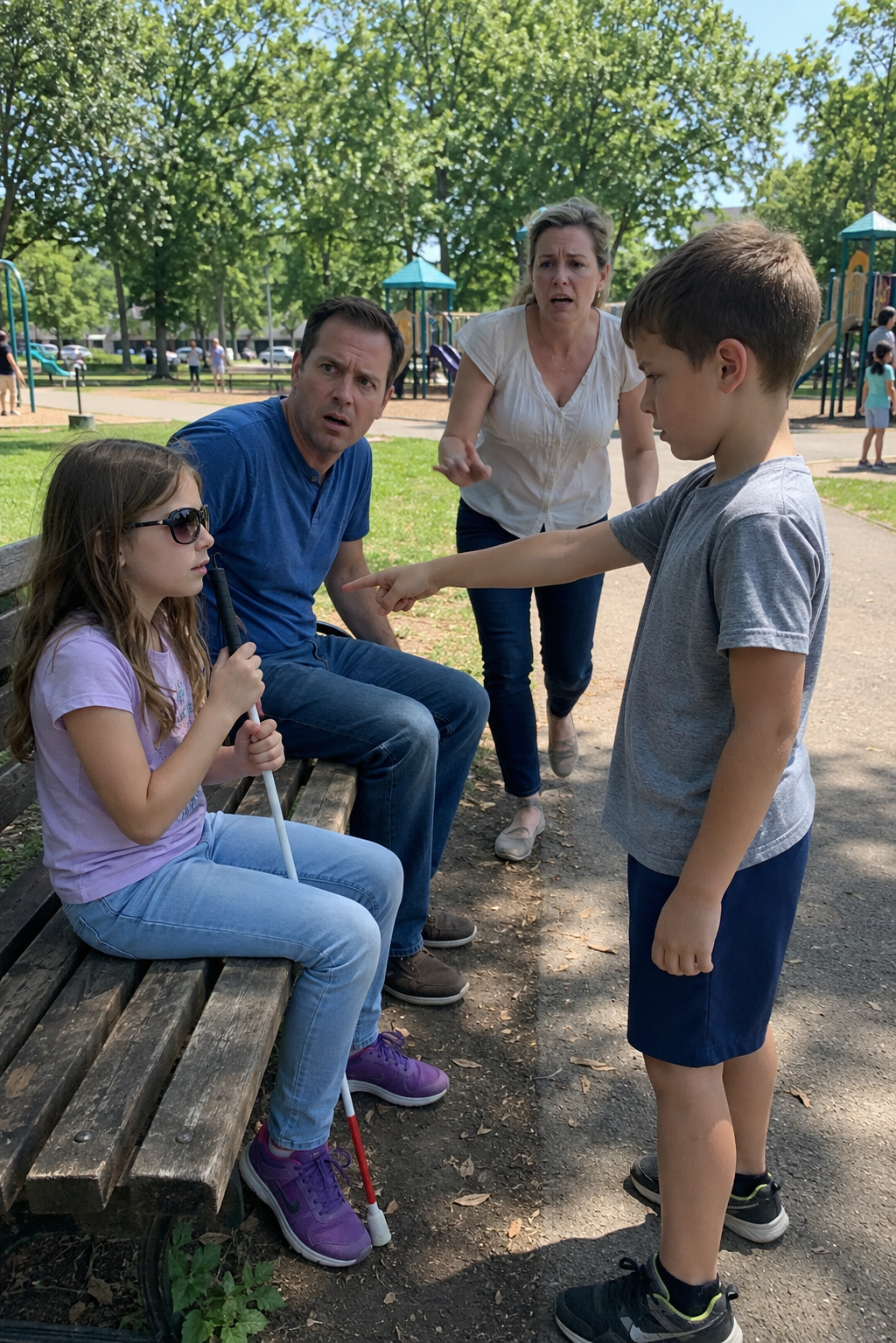
This Blind Daughter begins on an ordinary summer afternoon that seemed too peaceful to hide anything ugly. The park was bright, the trees were heavy with green leaves, and the sound of children playing drifted across the grass like background music from a normal life. Daniel sat on a wooden bench with his eight-year-old daughter, Nora, and tried to make the day feel safe. Nora wore dark glasses that covered most of her face, and a white cane rested across her lap while her fingers curled tightly around it. Daniel had spent months learning how to speak softly around her, how to steady his own voice, and how to believe what every doctor had told him. His daughter was blind, and he had built his whole world around that terrible truth.
But even then, something in the park felt unsettled. It was not the weather or the noise or the families passing by. It was the silence of a boy who stood near the path and watched them too carefully. He looked about Nora’s age, maybe a little older, with a serious face that did not belong to a child who wanted to play. He did not wave. He did not smile. He simply stared at Nora as if he had been waiting for the right second to step into their lives. When he finally started walking toward the bench, Daniel noticed that every muscle in his body seemed to tighten without warning.
Part 1: The Boy at the Bench
The boy stopped in front of Nora and raised one finger with shocking calm. “She is not blind,” he said.
Daniel felt the words hit him like a slap. For a second, he thought he had misheard. He looked from the boy to Nora and then back again, waiting for someone to laugh or correct the child or call him rude for making such a strange accusation. But the boy did none of that. He stayed still, his expression steady, his voice level, as if he had spoken an obvious fact that only adults were refusing to accept.
“What did you just say?” Daniel asked, his voice already thinner than he wanted.
The boy did not back away. “She can see,” he said. “Someone made her think she cannot.”
Nora held the cane tighter and tilted her chin down. Daniel watched her small hands and noticed how carefully she stayed in place, as if she had learned to be still whenever adults began sounding frightened. That scared him more than the boy’s words. It was one thing to hear a strange claim from a stranger. It was another thing to see your daughter react as if she had been trained to survive by hiding inside silence.
Daniel turned sharply when he heard footsteps hurrying down the path. Claire, his wife, appeared breathless and pale, her face tighter than it should have been. She looked at the boy first and then at Daniel, and in that instant he saw something in her expression that made his stomach drop. It was not confusion. It was fear. Real fear. The kind that arrives when a lie begins to crack in public.
“Don’t listen to him,” Claire said too quickly. “He is just a child.”
Daniel stared at her. “Then why do you look like that?”
Claire’s mouth opened, but no answer came out. The boy’s gaze moved from Daniel to Nora and back again. The little crowd nearby had grown quiet, as if the park itself had leaned in to hear what would happen next. Daniel felt his mind racing through every appointment, every prescription, every specialist visit, every careful instruction Claire had repeated at home. Keep the curtains closed. Keep the lights low. Do not let Nora strain herself. Do not question what the doctors said. Daniel had trusted all of it because he had loved Claire, and because loving someone often made him mistake control for care.
Then Nora lifted her head just enough to speak, and her voice was so small that Daniel almost missed it. “Mom said I was supposed to keep pretending.”
Claire went rigid.
The air around the bench changed. Daniel no longer felt like he was standing in a park. He felt like he was standing at the edge of a door he had never been allowed to open, and someone had just handed him the key.
“Pretending what?” Daniel asked.
Nora swallowed hard. Her lower lip trembled once, then she spoke again. “Pretending I couldn’t see things.”
Daniel’s knees felt weak. He looked at Claire, and this time he did not ask her to explain. He only watched her face collapse under the weight of being seen. The boy stood there without speaking, like a witness who had already given the most important testimony.
Claire finally took one step back. That was enough to tell Daniel that the truth was worse than anything he had imagined.
Part 2: The Blind Daughter and the Lie
Claire tried to speak, but Daniel did not let her hide behind half-truths anymore. He took Nora’s hand gently and asked the boy to stay where he was. The child nodded and said that he had seen Nora the week before at the ice cream stand near the school. He had watched her turn toward the sound of the truck bell. He had watched her look up at the bright wrapper in a little girl’s hand. He had not said anything then because he was not sure what he had seen. But after hearing Claire’s voice and watching Nora’s fear, he knew the girl on the bench was not blind at all.
Claire’s face turned white. “You should not be saying this,” she whispered.
Daniel stared at her. “Then tell me why he is saying it.”
She looked from Nora to Daniel and then down at the ground. For one awful second, she seemed unable to choose between lying again and admitting too much. Then her shoulders sagged, and the first real truth came out.
She said Nora had begun reacting to light again months earlier. She said the first doctor had noticed something “inconsistent,” but Claire had insisted the child was more fragile than they understood. She said she had become terrified that if Daniel learned Nora’s sight was returning, he would push for more tests, different doctors, and a new routine she could not control. She said she did not know how to stop the process once it started, so she kept guiding Nora into fear, kept dimming the rooms, kept reminding her that the world was too bright, too dangerous, too much.
Daniel could barely breathe. The pieces fell into place with horrible clarity. The strange appointments. The constant medication. The strict rules. The way Nora flinched whenever a curtain opened or a light switched on. This was not a tragic misunderstanding. It was a lie that had been fed to a little girl until she believed her own eyes could not be trusted.
He asked Nora to tell him what she could see right then, right there, in the park. Nora hesitated, then lifted her face toward the trees. “The bench is brown,” she said softly. “The leaves are bright. That boy’s shirt is blue.”
Daniel shut his eyes for a second because he could not bear how ordinary her words sounded. A child should not have to fight this hard to be believed. When he opened his eyes again, he saw Claire crying, not the kind of tears that asked for mercy, but the kind that came when the last wall between truth and consequence finally gave way.
Daniel did not scream. He did not need to. He called Nora’s pediatric clinic from his phone while still standing beside the bench and demanded every record, every note, every prescription. One nurse, shaken and apologetic, admitted that Nora had responded to movement and color in earlier visits, but Claire had repeatedly asked the staff not to question it in front of Daniel. She had told them the girl was overwhelmed, that she needed consistency, that she was not ready for “hope” yet.
By nightfall, the truth was confirmed by a new specialist. Nora was not blind. Her vision had been affected by the medication and by months of fear that had trained her to doubt what she saw. Once the false routine ended, the changes were immediate and unmistakable. The first time Nora looked out a hospital window without her glasses, she pointed at the red taillights in the parking lot and smiled through tears. Daniel cried too, because for the first time in months, his daughter was not reaching for a darkness someone else had built around her.
Claire lost access to Nora that same week while authorities and lawyers sorted through what had happened. Daniel did not feel triumph. He felt grief, anger, and a deep, aching sadness for the years of trust that had been twisted into control. The boy and his mother were later thanked by Daniel in a simple note, because they had seen what adults were too frightened to name. A child had spoken the truth in a park, and everything Daniel thought he knew had changed in a single afternoon.
In the months that followed, Nora learned to name colors, trees, faces, and distances for herself. Daniel watched her confidence return in small steps, and each one felt like a gift that had been stolen and returned. He never forgot the moment the boy pointed at his daughter and said she was not blind, because that was the moment the lie began to break.
Some truths arrive softly, but the ones that matter most can still change an entire family in an instant.