Part 1: The Shocking Inhaler Secret
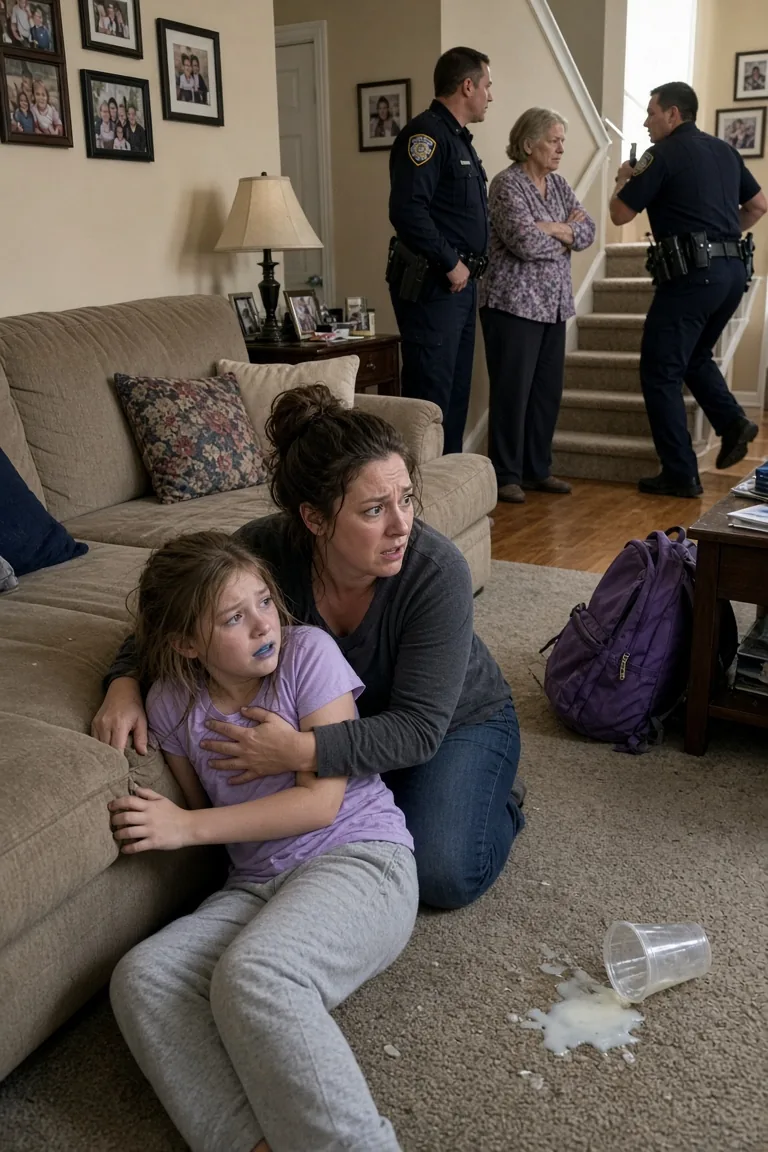
My former mother-in-law looked straight at two police officers and said my eight-year-old daughter could have her inhaler after she «learned respect.» Sophie was on the floor beside Patricia’s couch, her lips fading toward gray-blue while each breath came out as a frightening whistle. I knelt beside her while every instinct screamed we were running out of time. That morning, school was closed, and I had an important presentation. My ex-husband, Michael, was supposed to keep Sophie, but he called and said something had come up. His mother, Patricia, offered to help. Sophie did not want to go. I told her she would probably have fun once she got there. For months afterward, I hated remembering those words. By late afternoon, Sophie had stopped answering her phone. Patricia ignored my first few calls, then finally texted that Sophie was «sulking» because she had been corrected for bad manners. I called again. No answer. Something felt wrong. I left work early and drove straight to Patricia’s house. When I arrived, Patricia would not let me speak to Sophie. Then I heard something break inside. I called 911. Two officers arrived before Patricia opened the door. I found Sophie curled near the couch, her shoulders jerking with every shallow inhale. The sight of her frightened me more than anything I had ever seen in my life. I dropped beside her. «Baby, where’s your inhaler?» She tried to answer, but barely any sound came out. Patricia folded her arms. «I put it away.» For one second, I thought I had misunderstood. «You took her emergency inhaler?» Patricia did not deny it. She said Sophie had spilled milk, argued about cleaning it up, and rolled her eyes. According to Patricia, my daughter needed to understand consequences. Then she said, calmly, «She can breathe after she learns respect.» One officer immediately called for paramedics. The other demanded to know where the inhaler was. Patricia complained about his tone. Those seconds felt endless. Sophie’s body was becoming heavier against me, and I could feel the panic in the way she clutched my sleeve. I kept telling her help was coming even though I was terrified that I was lying. Finally, Patricia admitted the inhaler was upstairs in her bedroom. The officer ran. The paramedics arrived almost at the same moment he came back down holding Sophie’s blue rescue inhaler. They began treating her right there on the floor. Then Sophie looked at me through the oxygen mask. «Mommy,» she whispered, «I said sorry.» My stomach dropped. I asked what she meant. She told me she had already apologized for yelling and knocking over the milk. Patricia still would not return the inhaler. Patricia immediately claimed Sophie had thrown her plate. Sophie weakly shook her head. «It was a cup.» That tiny correction changed the room. For the first time, I realized Patricia was already rewriting what had happened. Sophie then told us Patricia had made her stand by the wall for what felt like an hour. When her chest tightened and she started coughing, Patricia accused her of pretending so she could escape punishment. When Sophie asked for her inhaler, Patricia called her dramatic. When Sophie tried to call me, Patricia took her phone. I stared at the woman who knew my daughter’s asthma history, knew stress could make an attack worse, and had been told more than once exactly what to do in an emergency. Patricia still insisted Sophie had «worked herself into this state.» I thought the worst had already been uncovered. Then the officer who had gone upstairs returned again. This time, he was carrying a clear plastic medication box. Inside were Sophie’s backup inhaler, her allergy medicine, and the laminated asthma action plan from her doctor. The room went silent. The officer looked at me and asked one question. «Ma’am, does all of this belong to your daughter?» I said yes. Then he told me where he had found it.
Part 2: The Heartwarming Lesson of Family
The officer found Sophie’s medication box behind blankets in Patricia’s bedroom closet. Her phone was in a nearby drawer. That detail destroyed Patricia’s explanation. She had removed every emergency medication Sophie carried, taken her phone, and hidden both beyond her reach. Patricia’s face hardened. «You’re making this sound worse than it was,» she said. As Sophie was moved toward the ambulance, the second officer asked Patricia to turn around. She looked genuinely stunned. «You’re arresting me?» I followed the paramedics outside, holding Sophie’s hand as they loaded her into the ambulance. «Mom,» she whispered through the oxygen mask, «am I still in trouble?» I leaned close. «No. You are not in trouble. And you will never have to earn medicine, food, safety, or the right to breathe.» Her fingers tightened around mine. At the hospital, doctors stabilized her. I sat beside her bed, grateful, furious, and sick with guilt. Michael arrived later. He entered pale and shaken, asking what happened. I told him everything. At first, he said, «My mother wouldn’t do that.» Then I showed him the officer’s inventory. His expression changed. Sophie woke while we were talking. When she saw her father, she turned her face toward me. He sat beside the bed and apologized. Sophie listened quietly. Then she asked him a question. «Why did Grandma think I was lying when I couldn’t breathe?» Michael had no answer. Neither did I. The next morning, an investigator spoke with Sophie. She repeated the same story: the spilled milk, the punishment by the wall, the coughing, the request for her inhaler, the apology, the phone being taken, and Patricia refusing to return the medication. Her story never changed. Patricia’s did. First, she claimed she had hidden the medicine for only a few minutes. Then she said Sophie had never asked for it clearly. Later, she claimed the attack was fake. But the asthma action plan had been hidden in the same box. Patricia knew exactly what the medication was for. What happened in that living room could never be reduced to a misunderstanding, because Sophie had asked for help, apologized, struggled to breathe, and still had been deliberately denied medicine. By discharge, I had made my decision. There would be no more unsupervised visits. Michael agreed. For once, he did not defend his mother. Patricia called repeatedly afterward. She left messages saying everything had been misunderstood, that she loved Sophie, and that families should not involve police in discipline. I saved every message. I did not argue with her. The criminal case moved forward, and Patricia was ordered to have no contact with Sophie while it was pending. Months later, she accepted responsibility in court rather than forcing Sophie to testify. The judge imposed probation, mandatory counseling, and a continued protective order. But the legal outcome was not the part that mattered most to me. Sophie was. For weeks, she kept her inhaler close enough to touch. She checked her backpack before school, before bed, and even before walking to the mailbox. So we built a new routine. One inhaler stayed with her. Another stayed with me. Her school had the emergency plan. And every adult responsible for her understood one rule: medicine was never punishment. Eventually, Sophie stopped asking whether she was «allowed» to use it. One evening, months later, she came into the kitchen after playing outside and calmly said her chest felt tight. She reached for her inhaler without looking afraid. I watched her take it, breathe, and relax. Then she looked at me. «I don’t have to ask, right?» I shook my head. «Never.» That was when I realized the real damage had finally started to heal. Patricia had tried to teach my daughter obedience by making breath conditional, but Sophie learned something stronger: no adult gets to turn safety into a reward. Sometimes protecting a child means ending access to someone who insists love gives them control. What boundary would you set after someone endangered your child and still refused to understand why it was wrong?
Discover more heartwarming stories and emotional moments on our main editorial page.