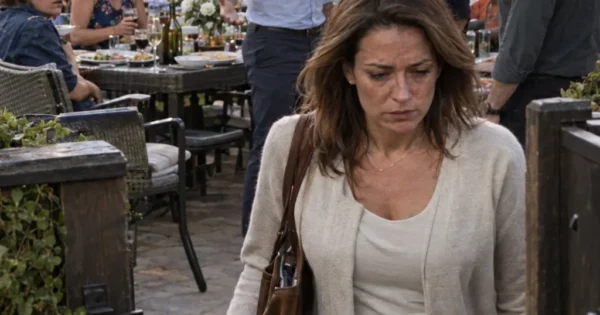
This mother boyfriend betrayal brother begins with a kitchen scene that shattered every assumption about family safety.
Table of Contents
Part 1: mother boyfriend betrayal brother Investigation Begins
I thought I was running down to the kitchen for a cheap panic and a quick apology.
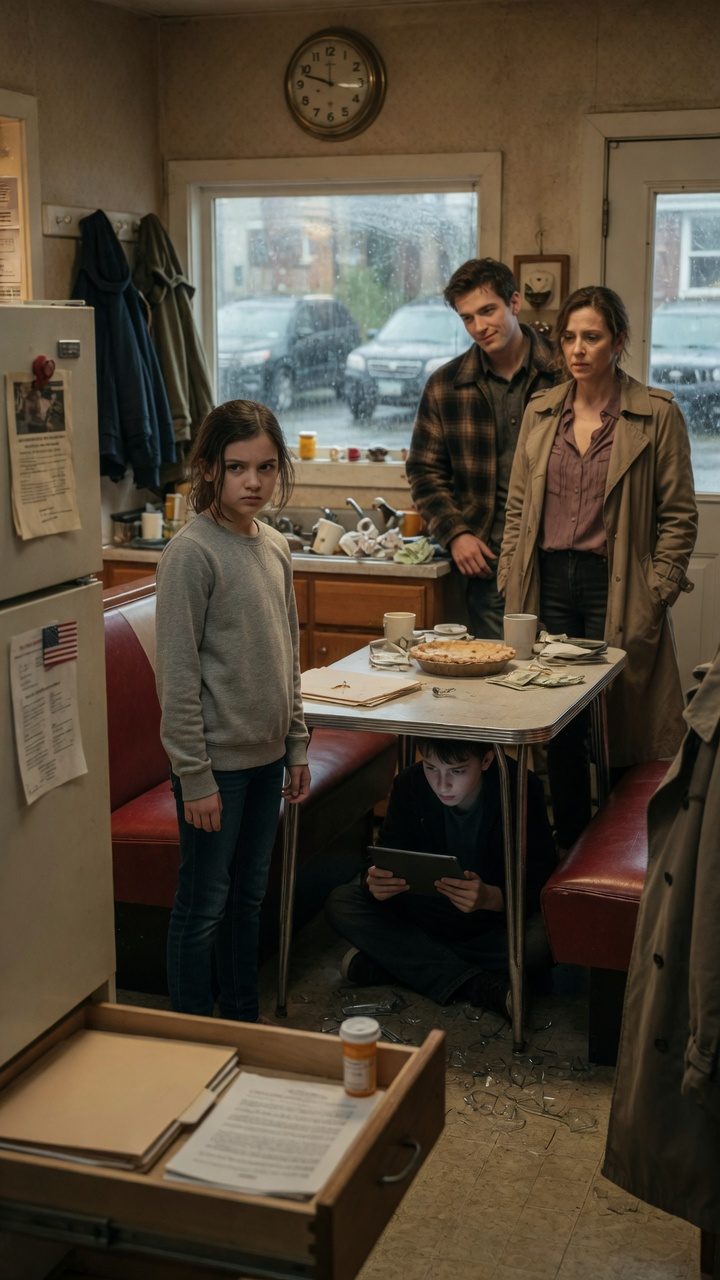
Daniel was under the table when I got there, folded so tight his knees nearly touched his chin.
One hand covered his left ear while the other searched for the edge of a chair.
His glasses were snapped at one temple, the metal frame twisted beyond repair.
A dark mark circled his wrist, then another higher up where fingers had gripped too hard.
He kept staring at the tile as if looking up might make the room louder.
Don’t tell them, he said, his voice barely a whisper against the humming refrigerator.
Mom stood by the sink with her arms crossed, still in her work blouse stained with coffee.
He had another episode, she said, her tone flat and rehearsed like a script she had memorized.
Your brother gets worked up, she added, not looking at Daniel once.
Her boyfriend leaned against the counter with a coffee mug in his hand, the kind of man who always looked relaxed in other people’s pain.
He came at me first, he said, shrugging as if discussing weather instead of violence.
I barely touched him, he lied, his eyes never meeting mine.
Daniel flinched when he spoke, not at the words but at the volume that rattled the windowpanes.
That was the part they always missed about my brother’s condition.
Daniel hated noise with a visceral intensity that made his skin crawl.
Sudden shouting made him go still, not wild, his body freezing like a deer in headlights.
He covered his ears when the blender ran too long, the high-pitched whine piercing his skull.
He lined up his pencils in color order when he was anxious, a ritual that brought momentary control.
He spent his whole life trying not to be a problem for anyone, shrinking himself into corners.
The phone video I had gotten from a neighbor was only twelve seconds long.
Twelve seconds was enough to see Mom’s boyfriend step into Daniel’s path deliberately.
Twelve seconds captured Daniel saying please don’t with a desperation that broke something inside me.
Twelve seconds showed my brother hit the pantry door and slide down hard before the camera shook.
No one had helped him, not Mom, not the boyfriend, not the two women by the back door.
The women had seen enough to understand and too much fear to say a word aloud.
Inside that kitchen everyone was suddenly interested in becoming invisible, studying their shoes.
I took Daniel to the emergency room myself, my hands white-knuckled on the steering wheel.
He sat in the passenger seat with his forehead against the cold window glass.
One hand gripped the tablet he used to type when speaking got too hard.
Every stoplight looked like it hurt him, each red glow stabbing at his sensitivity.
The doctor asked questions Mom should have answered months ago about recurring injuries.
A nurse set a blanket across Daniel’s lap and looked at his wrists a second too long.
No one said the word abuse out loud in that sterile room with its antiseptic smell.
They did not have to speak it for the weight to settle in my chest.
When we came back, Mom was gone but her boyfriend’s truck was still in the drive.
Daniel pointed at his bedroom door before I could ask a single question.
Then at the coat hook by the hall where shadows gathered in late afternoon.
Then at Mom’s winter coat, still hanging there like a sentinel waiting for orders.
The key was inside the lining pocket, cold metal against my trembling fingertips.
The drawer in Daniel’s room was locked with a little brass lock I had never noticed before.
Inside were guardianship papers that said he was mentally incapable of making decisions for himself.
There was a life-insurance policy with Mom listed as sole beneficiary in bold print.
There were trust papers too, naming her as the person who would take control of Dad’s account.
The account would transfer if Daniel were ever institutionalized, the legal language precise and cruel.
My hands went numb before I even got to the bottom stack of documents.
There was a schedule typed on crisp white paper, dated and detailed with military precision.
Day before eval, raise noise, the first line read in clinical detachment.
During eval, provoke, the second line commanded like a battle plan.
Film only after reaction, keep him tired, keep him confused, the instructions continued.
One line had a note in the margin written in blue ink: Do not let sister get alone with him.
Then I found the recordings hidden in a false bottom of the drawer.
Not one recording but several files labeled with dates spanning six months.
Mom’s voice was on the first file, flat and careful, saying after tomorrow he loses the trust.
Her boyfriend answered, and if his sister interferes, his tone casual as grocery lists.
She won’t have time, Mom replied, and I heard the chill of premeditation in her voice.
I sat on Daniel’s bed listening to my mother plan my brother’s life like she was setting a dinner table.
The house was quiet in that ugly way it gets right before neighbors start noticing something is wrong.
A sheriff’s flyer about community watch was still stuck to the fridge with a magnet shaped like a peach.
Then I heard the back gate slam shut with finality that vibrated through the floorboards.
Mom was home early, her footsteps heavy on the porch steps.
And Daniel had just typed one new sentence on his tablet, the screen glowing in dim light.
Some people say the smartest move is to wait until you have every page and every witness.
Others say the first duty is to get the person in front of you out of danger immediately.
When the person hurting your brother is also your mother, the line between caution and betrayal gets thin fast.
Pinned Comment Suggestion: Did you catch who was missing from every one of those recordings? That detail is the reason this case got ugly so fast.
Part 2: mother boyfriend betrayal brother Truth Emerges
His tablet screen lit up the dark bedroom like a little window into his mind.
CHECK MOM’S COAT CAMERA, the text read in capital letters that seemed to pulse.
I read it twice before I understood what he meant, my breath catching in my throat.
Then I was already moving because Daniel had never wasted words in his entire life.
His hands were shaking too hard to keep the device steady on his lap.
The camera was stitched into the seam of Mom’s beige coat, hidden behind a torn patch near the hem.
She wore that coat when she wanted to look like the worried parent instead of the woman steering the whole thing.
The file from the camera was worse than the papers, worse than anything I had imagined.
It showed the kitchen from above, a bird’s-eye view of calculated cruelty.
Mom standing near the stove, her posture relaxed, one hand on her hip.
Her boyfriend walking Daniel toward the pantry with a grip on his upper arm.
The sound of my brother asking them to stop, his voice thin and breaking.
Then the boyfriend stepping in close, blocking the door with his broad shoulders.
And Mom not moving, not after the shove, not after Daniel hit the floor hard.
Not even when he started to cry, the sound muffled against the pantry door.
She told the camera, in a voice so calm it made my skin crawl, keep him scared, not injured.
Her boyfriend laughed under his breath, a low chuckle, same difference, he muttered.
The back door opened again while I was still staring at the screen, frozen in horror.
This time it was the police, two uniforms and a county detective with gray at his temples.
Mom came in right behind them, one hand at her chest, the other trembling on purpose.
Daniel froze at the desk, his body rigid, eyes darting between the officers and me.
I held up the tablet before anyone could start speaking for him or spinning narratives.
I have the recordings, I said, my voice steady despite the earthquake inside me.
Her boyfriend tried to get ahead of it, words tumbling out in practiced defense.
She’s upset, Daniel’s unstable, this is part of his pattern, he claimed smoothly.
He kept talking but the detective had already seen the bruises on Daniel’s wrists.
He had already seen the broken glasses on the bed, the twisted frames catching light.
And the moment he listened to the first file, the room changed shape entirely.
Mom’s face went blank, all expression wiped away like chalk from a board.
The detective pulled the guardianship papers from the drawer and laid them beside the insurance policy.
Then he found Dad’s toxicology report under the same stack, folded inside a church envelope.
The envelope was cream-colored with a gold cross, meant to keep it hidden until it was too late.
The report showed a dose that did not belong in a man with Dad’s cardiac history.
A bottle from my purse matched the prescription number on the label exactly.
I had never seen that bottle before in my life, my fingers never touched those pills.
The detective saw that the second he looked at my hands, clean and empty.
Mom pointed at me anyway, her finger sharp and accusing across the room.
She killed him, she said, her voice rising with manufactured grief.
Her boyfriend nodded too fast, like he had been waiting for that line, rehearsed and ready.
Daniel stood up so suddenly his chair hit the wall with a crack like a gunshot.
He was crying without sound, tears streaming down his face in silent rivers.
One hand pressed to his tablet, the other braced on the desk for support.
The detective looked at the camera file again, then back at Mom with cold eyes.
You want to explain why your coat camera recorded you discussing your husband’s pills?
Nobody answered, the silence stretching until it became a physical weight in the air.
That was the moment the truth stopped being a rumor and turned into evidence undeniable.
Mom tried one more time to speak over it, her voice rising in desperate deflection.
The boyfriend muttered something about attorney, about mistake, about misunderstanding, words collapsing.
But the front yard was filling up now, more cars arriving with flashing lights.
More lights painted the neighbors’ faces as they came outside, drawn by the commotion.
The neighbors had seen enough to come outside, their curiosity hardened into witness.
Daniel typed one last line and turned the tablet toward me, screen bright in the chaos.
HE DISCOVERED IT, the words glowed, simple and devastating in their implication.
He meant Dad, our father who had died six months ago in his sleep supposedly.
Dad had found out before he died, discovered the plot against his son.
The detective saw it too, his jaw tightening as the pieces clicked into place.
He asked for the rest of the files and I handed them over without hesitation.
There were dates and times and audio clips, more than one evaluation staged.
More than one episode manufactured, a paper trail built to make Daniel look dangerous enough to erase.
Mom stared at the floor like it might open and save her from consequences.
Her boyfriend finally stopped talking, his mouth closing as the reality settled.
And for the first time all night, Daniel looked at the room instead of through it.
He lifted his chin a little, just enough to prove he was still there, still fighting.
Sometimes justice starts quietly, without fanfare or dramatic speeches in courtrooms.
Sometimes it starts with one brother choosing to be believed after years of silence.
And one sister deciding she is done being useful to a lie that nearly destroyed them.
He never had to say another word aloud for the truth to be heard clearly.
The whole house had already heard him through the tablet and the recordings and the evidence.
A parent can destroy a child and still expect the world to call it family business.
Maybe that is why I keep wondering whether I should have called the police sooner.
Even if it meant tipping my mother off, even if the case got messier later.
Some people say you protect the evidence first, build the case brick by brick.
Others say you protect the person first, pull them from the fire immediately.
When those two answers do not match, what do you do when the fire is your own mother?
Discover more unforgettable stories and truth revelations on our main editorial page.