This pharmacy prescription begins with a young woman standing outside the doors of a pharmacy, taking a deep breath before stepping inside.
She holds a worn prescription and a handful of coins, which barely make a sound when they touch, representing every dollar she has left after weeks of choosing food over comfort and hope over despair.
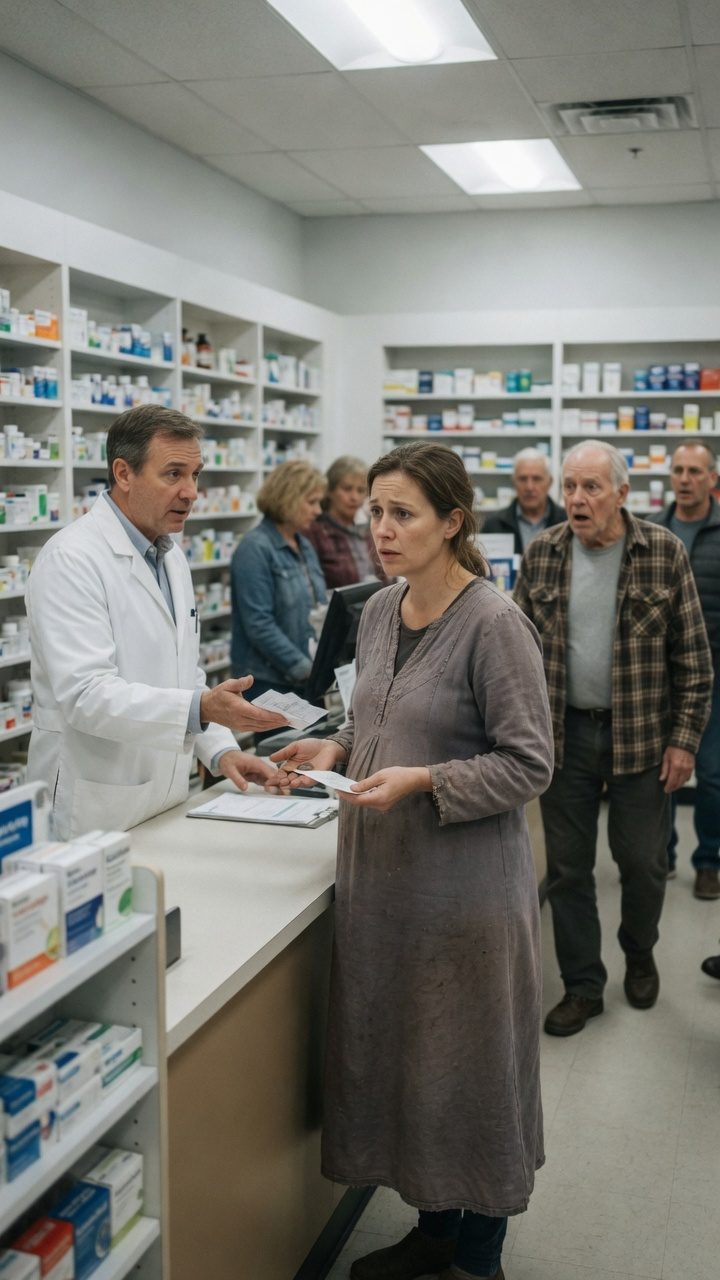
The pharmacy is bright, spotless, and quiet, with customers browsing shelves while soft music plays overhead, creating a sense of calmness that contrasts with the woman’s anxiety.
For a brief moment, she imagines that maybe today someone will simply see her as another mother trying to protect her child, rather than a struggling individual.
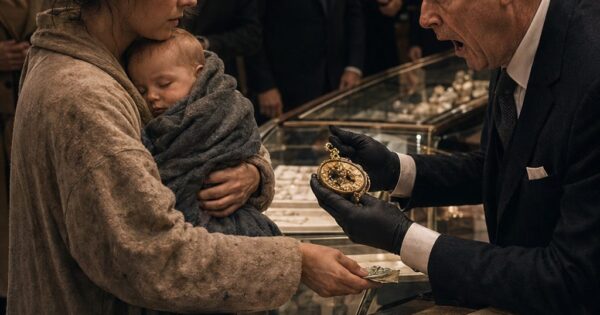
She approaches the counter with a nervous smile and carefully places the prescription beside the coins, hoping that the pharmacist will understand her situation.
The pharmacist barely glances at the paper before looking at the small pile of money, and his expression changes instantly, becoming dismissive and unhelpful.
Without asking a single question, he pushes the prescription back across the counter, stating that the medication costs more than the woman has, and that they don’t work with payment plans.
The woman quietly explains that she understands, and that she’s not asking for charity, but rather hoping to find a way to pay the rest later, but the pharmacist remains unmoved.
Several customers turn to watch, some looking uncomfortable, while others quickly look away, pretending not to notice, and one customer even mutters that people shouldn’t expect special treatment.
The woman’s face turns red with embarrassment as she picks up the prescription with trembling hands, trying not to cry, and whispers, «I just want my baby to be healthy.»
The pharmacist remains unmoved, stating that the rules are the rules, and the room falls silent, with the woman convinced that she’s reached the end of every possible path.
Then, a voice interrupts, «Wait,» and an elderly man who had been sitting quietly near the back stands up, his eyes fixed on the prescription, not the woman.
He walks forward, much faster than anyone expects for someone his age, and reaches the counter, carefully looking at the signature printed at the bottom of the page.
His face loses all color, and he looks from the paper to the young woman, as if trying to solve a mystery that has haunted him for years, and finally asks, «Who gave you this prescription?»
The woman blinks in confusion, having expected pity or another rejection, but not someone recognizing the signature, and the pharmacist becomes uneasy, reaching for the paper again, this time more carefully.
The elderly man refuses to let go, his eyes remaining locked on the signature, which seems to change everything inside the room, and the woman wonders what could possibly be so important about the name written on an ordinary prescription.
Part 1: The Pharmacy Prescription That Changed Everything
The elderly man’s question hangs in the air, and the woman shakes her head, explaining that the doctor treated her after another clinic turned her away, and that he never told her anything except that she needed the medicine.
The older man smiles sadly, stating that the doctor wouldn’t have, and the pharmacist tries to interrupt, insisting that business should continue as usual, but the elderly man calmly introduces himself as one of the physician’s oldest friends.
He explains that the doctor whose signature appears on the prescription had spent decades helping families who had nowhere else to turn, and that he had established a private fund that quietly covered medications for struggling parents without asking for recognition.
Very few people knew the program existed, and the pharmacist certainly should have known, but the elderly man asks him one simple question, «Did you bother reading the entire prescription?»
The pharmacist unfolds the paper completely, and a second page is attached, with instructions authorizing the pharmacy to provide the medication immediately through the assistance program.
The pharmacist had dismissed the woman before checking the complete document, and his face turns pale as he realizes his mistake, and every customer in the pharmacy has now witnessed what happened.
Without saying another word, the pharmacist retrieves the medication, prepares the order, and quietly apologizes, and the young woman can’t believe what she’s hearing, tears filling her eyes, not because someone has finally helped her, but because a complete stranger has cared enough to stop and look closer.
Part 2: The Final Truth About the Pharmacy Prescription
Before leaving, the elderly man hands the woman a small envelope, explaining that the doctor asked him years ago to deliver these whenever he met someone carrying one of his special prescriptions.
Inside the envelope is information about prenatal care, transportation assistance, and additional support for new mothers, and the elderly man tells her, «You and your baby won’t have to face this alone.»
Weeks later, the woman returns to the pharmacy, not because she needs help, but to thank everyone who stood beside her that day, and the pharmacist greets her differently, admitting that he had become so focused on procedures that he had forgotten the reason his profession existed in the first place.
From then on, he promises himself to slow down, read carefully, and remember that every prescription represents someone’s family, someone’s future, and someone’s hope, and the woman leaves the pharmacy feeling grateful and relieved.
Sometimes the greatest mistake isn’t refusing to help, but failing to see the whole story before making a decision, and the woman’s experience serves as a reminder of the importance of compassion and understanding in our daily lives.
Discover more unforgettable stories and truth revelations on our main editorial page.