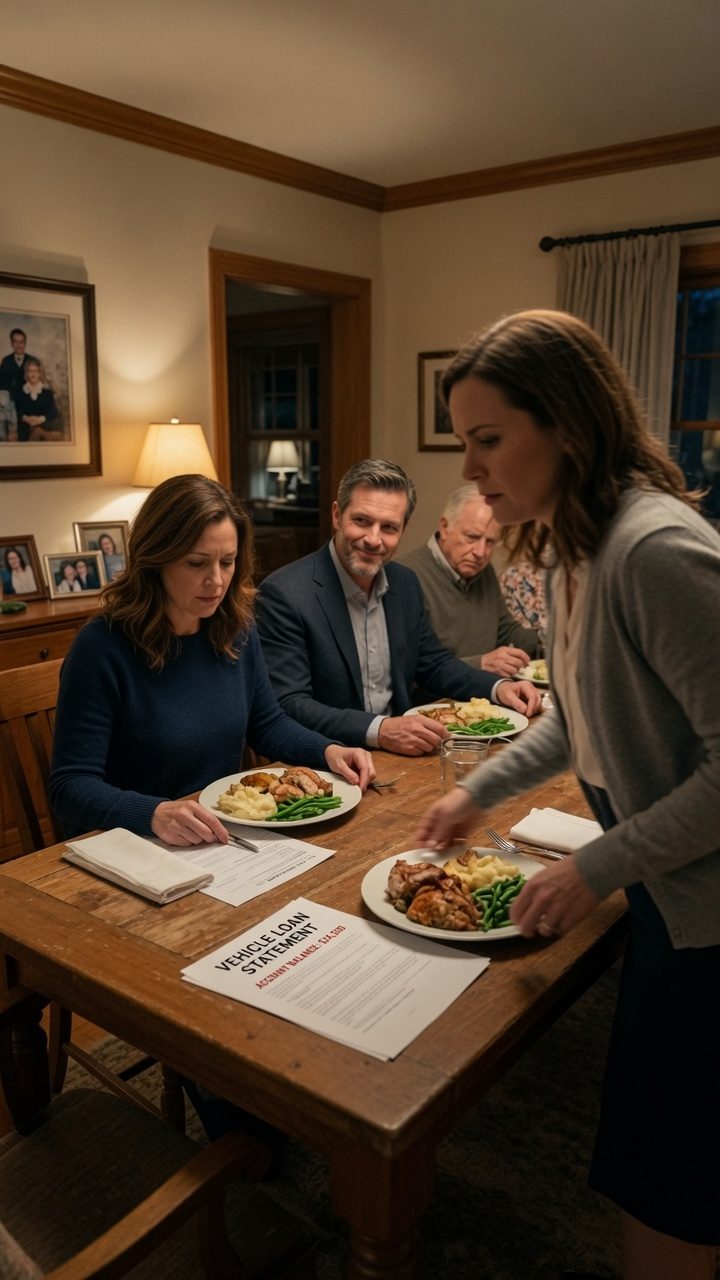
This Family Financial Abuse begins with a story of a family dinner that turned into a nightmare. Family dinners were supposed to be about catching up, laughing over old stories, and leaving with leftovers. Mine turned into something else entirely.
The moment my sister slid a stack of papers across the table, I knew this wasn’t an invitation—it was an ambush. She smiled as if she were asking for the salt.
«Twenty-five hundred dollars a month,» she said. «Just until we get back on our feet.» I stared at the loan statement. It wasn’t for groceries. It wasn’t for medical bills. It wasn’t even for rent.
It was for a luxury SUV she had proudly shown off online just months earlier. Before I could answer, her husband leaned back in his chair and casually added that refusing would mean I wasn’t welcome in the family anymore.
No one protested. Not my parents. Not my relatives. No one looked shocked. Instead, they all watched me as if my role had already been decided long before dinner was served.
Apparently, because I worked hard, lived below my means, and didn’t spend money trying to impress strangers, I had become everyone’s emergency fund. Funny how they called me «lucky» for not having children.
Lucky for working from home. Lucky for saving. They never called me disciplined. They never mentioned the dental bills, overdue taxes, emergency rent, or expensive «business opportunity» I’d quietly paid for over the years.
Those payments were forgotten the moment another hand reached into my wallet. When I asked why I should pay for someone else’s dream car, the room acted as though I had committed the real offense.
My father criticized my attitude. My mother reminded me my sister had children. Her husband insisted family should help family. Yet no one asked why they believed my savings belonged to everyone except me.
The conversation became less about a vehicle and more about something much bigger. Respect. Boundaries. And whether love could survive when it came with invoices attached.
Then came the sentence that changed everything. «If you don’t help us,» he said, «don’t come back.» Silence filled the room. Everyone waited for me to apologize.
Instead, I quietly folded my napkin, placed it beside my untouched dinner, stood up, and gave the only answer that finally felt honest. «Then I’m out.» I walked away without looking back.
I thought the hardest part was over. I was wrong. Because when I woke up the next morning, my phone showed sixteen missed calls. Every single one came from the dealership.
Why would a dealership suddenly be trying so desperately to reach me? And what had my family done after I walked away?
Part 1: Family Financial Abuse and the Ultimatum
I had never felt so isolated and disrespected by my own family. The fact that they would use guilt and manipulation to get me to pay for something I didn’t want to pay for was appalling.
I realized that I had been enabling their behavior for far too long. I had always been the one to help out, to lend a hand, to give in. But this time, I had to draw a line.
I couldn’t just give in to their demands and expect everything to go back to normal. I had to take a stand and show them that I wouldn’t be taken advantage of.
It wasn’t easy, but I knew it was necessary. I had to prioritize my own financial stability and well-being over their expectations.
I thought about all the times I had helped them out in the past, and how they had never shown any appreciation or gratitude. It was always about what they could get from me, never about what they could give back.
I felt a mix of emotions: anger, sadness, and frustration. But most of all, I felt a sense of determination. I was determined to take control of my finances and my life.
I knew that I would have to face the consequences of my decision. I would have to deal with the fallout and the potential damage to our relationships. But I was willing to take that risk.
Because in the end, I knew that I was doing what was best for me. And that’s all that mattered.
Part 2: The Aftermath and the Road to Recovery
When I finally answered one of the calls from the dealership, the representative asked if I was still willing to discuss the overdue vehicle account. I told her she had the wrong person.
She paused before asking, «Are you Mia?» I said yes. Then she explained exactly why they kept calling. Someone had listed me as the financial contact and secondary responsible party during the purchase process.
Except I had never signed anything. I had never agreed to anything. I had never even visited the dealership. The representative immediately stopped the conversation once I denied any involvement and advised me to review my credit reports.
Within an hour, I discovered an inquiry connected to the vehicle loan. That was enough for me. I froze my credit, gathered every document I could find, and contacted the dealership’s fraud department.
A few days later, the calls from my family began instead. Not apologies. Excuses. My sister insisted it was only meant to «speed up the paperwork.» Kyle claimed they assumed I wouldn’t mind because I had always helped before.
My parents begged me not to «make this bigger than it needed to be.» But it already was. For years, every favor had quietly become an expectation. Every act of generosity had convinced them that my financial stability belonged to everyone else.
This time, I refused to carry the weight. The dealership completed its investigation. My name was removed from every document connected to the account. The loan remained exactly where it belonged—with the people who had chosen to buy the SUV.
A few months later, the vehicle was repossessed. I heard about it through relatives who suddenly remembered how to call after weeks of silence. Life became quieter after that. Painfully quiet at first. Then peacefully quiet.
I stopped answering demands disguised as family emergencies. I stopped apologizing for saying no. Most importantly, I stopped believing that love had to be purchased to be accepted.
Eventually, a few relatives reached out privately. Some admitted they had stayed silent because they were afraid of becoming the next target. Others apologized for watching without speaking.
Trust didn’t return overnight. Some relationships never recovered. But for the first time in years, every dollar I earned reflected my own choices instead of someone else’s expectations.
Walking away from that dinner cost me the version of family I thought I had. It also gave me the freedom to build healthier boundaries for the future.
Sometimes the hardest word to say is «no.» Sometimes it’s also the word that changes your life for the better.
Discover more unforgettable stories and truth revelations on our main editorial page.