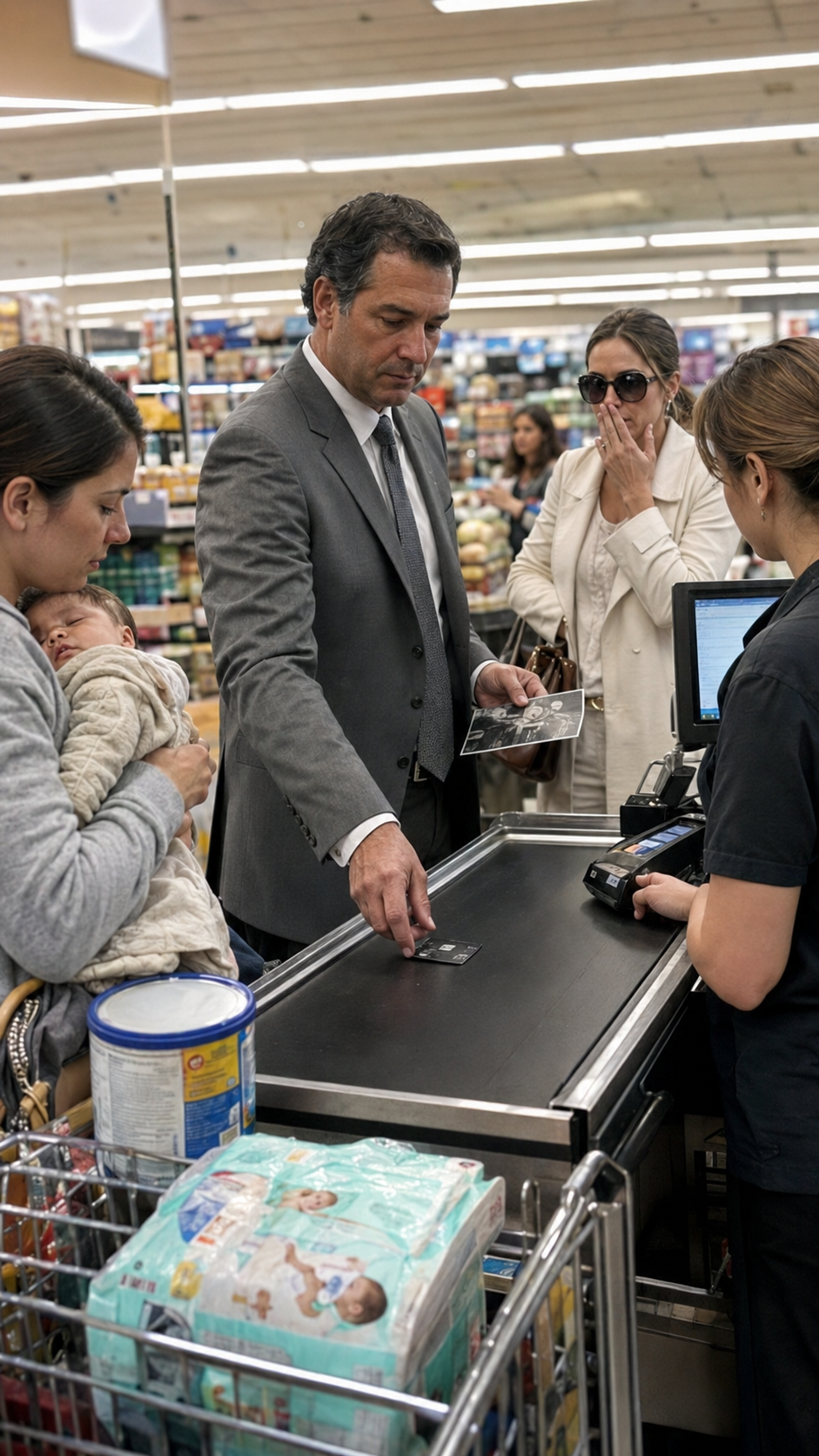
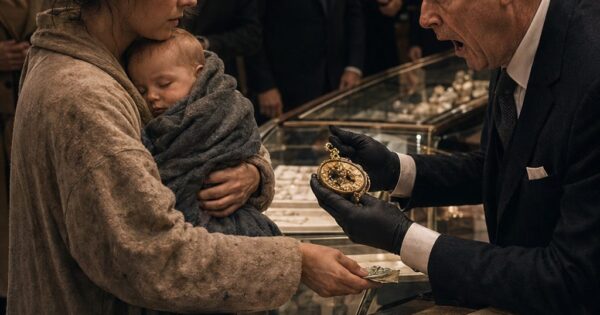
This Checkout Kindness begins under the harsh white lights of a busy American supermarket, where every sound seemed louder than it should have been and every waiting customer seemed to grow more impatient by the second. A young mother stood at the register with a sleeping baby tucked against her chest, trying to keep both her composure and her child settled while the last of her groceries were scanned one by one. She had chosen the most basic items she could find, thinking carefully about what would stretch through the week. Even so, the total climbed higher than she could cover. What happened next looked simple from a distance, but it carried a weight the store would not understand until much later. That is why this Checkout Kindness story stayed with everyone who saw it.
Part 1: The Register Line
The woman had arrived at the store already tired, already worried, and already doing the quiet math that so many people do when money runs low. Her cart held only necessities: formula, diapers, a few groceries that could make several meals, and a small item or two she hoped would keep her from needing another trip too soon. The baby in her arms slept with the fragile trust of an infant, and she kept one hand pressed softly against the child’s back as if she could shield him from the pressure building around her.
When the cashier finished scanning the last item, her expression changed in a way that made the mother’s stomach tighten before the words even came out. The amount on the screen was not impossible, but it was still too much.
“You’re twelve dollars short,” the cashier said, not unkindly, but with the flat certainty that comes from handling situations like this every day.
The mother looked down at her wallet and felt the small, ugly disappointment of confirmation. She already knew there would not be a secret bill tucked behind a card or a forgotten coin at the bottom of her purse. The line behind her shifted. Someone sighed. Someone else looked away as if the moment had become inconvenient simply because it existed in public.
Trying to keep her voice steady, she said she could put the formula back. She said it quietly, almost apologetically, as though she were asking permission to solve the problem by giving up the one item that mattered most. The cashier paused. The mother’s face lowered. That was when a woman a few places back in line, dressed in expensive clothes and oversized sunglasses, let out a cold laugh that made the entire lane feel even smaller.
“If you cannot afford a child,” she said, “you should not have had one.”
The words landed hard. The young mother froze. She did not answer. She only tightened her arms around the baby and stared at the conveyor belt as though looking at it could somehow keep her from breaking in public. The cashier glanced down, uncomfortable. A few customers pretended not to hear. Others looked directly at the mother, and none of those looks offered help.
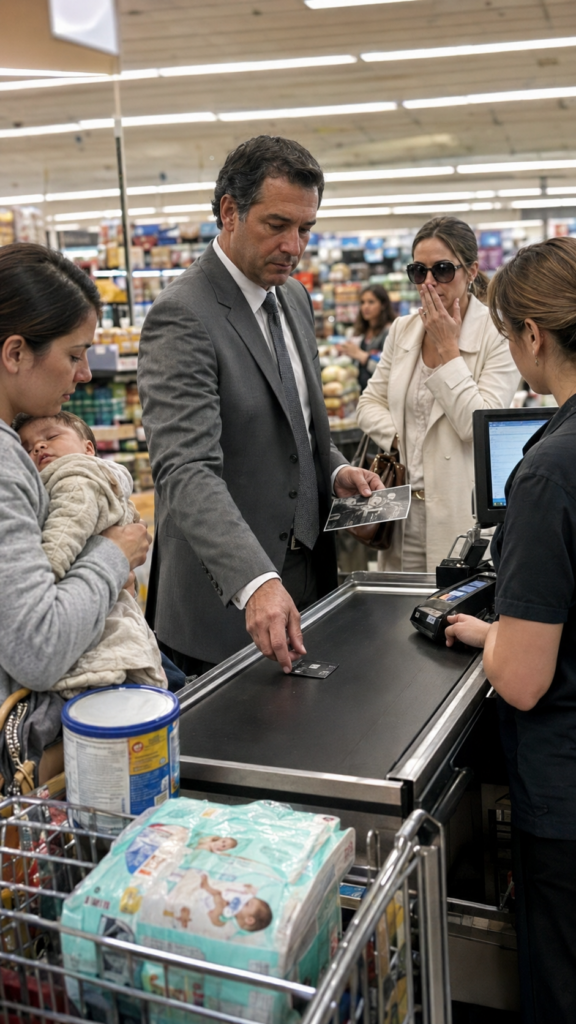
Then a man in a plain gray suit stepped forward from farther down the line. He was middle-aged, calm, and almost startling in how ordinary he seemed compared with the tension around him. He did not raise his voice. He did not speak to the woman who had insulted the mother. He only took out a black card and placed it on the counter with a steady hand.
“Pass everything through,” he said.
The cashier blinked. “Everything?”
He nodded once. “The formula, the diapers, the groceries. All of it.”
The mother shook her head immediately and said she could never let him do that. She did not know him. She did not know how she would ever repay him. She did not know why he would offer such help to a stranger in a checkout line. The man looked at the sleeping baby and, for just a second, his expression changed in a way no one else understood.
“You already have,” he said.
The line went still. Even the woman in the sunglasses stopped moving. The cashier began ringing up the rest of the items in silence while the man reached into his coat and carefully pulled out an old photograph whose edges had softened with time. He did not hold it up for show. He only looked at it, and then looked at the mother again, as though the sight of her had unlocked a memory he had carried for years.
The mother stared at the photograph, confused and frightened by the sudden shift in the room. She had never seen him before. Yet he was looking at her with the kind of recognition that belongs to someone who has waited a long time for a moment to arrive. Nothing in that checkout lane made sense yet, but the air around them had changed. The shame that had been hanging over her seconds earlier no longer felt like the strongest thing in the room. Something older and deeper had taken its place.
Checkout Kindness story moment
Part 2: The Photograph
The man kept the photograph in his hand for a moment longer, then turned it so the mother could see it clearly. Her eyes moved over the faded image, and then she recognized the face looking back from the past. It was her late mother, younger and smiling in a way the daughter had not seen for years. The realization hit her so fast that she had to grip the cart for balance.
Her voice came out barely above a whisper when she asked how he had that picture.
The man’s expression softened. He said that twenty-six years earlier, he had been at a low point in his life. He had been broke, embarrassed, and trying to survive one day at a time. He had walked into the same supermarket long before the store looked the way it did now, and he had stood in almost the same place with almost nothing in his wallet. Your mother, he explained, had noticed him before anyone else did. She did not just see a stranger who looked unlucky. She saw a human being who needed help and dignity at the same time.
According to him, she bought groceries for him that day without asking for a promise in return. She handed him the old photograph as well, telling him that kindness was never wasted, even when it seemed small. She told him to keep it as a reminder that one family’s compassion can change the path of another life. He had never forgotten that moment. He carried the picture through moves, setbacks, and years of rebuilding until he finally became the kind of person who could quietly do for someone else what had once been done for him.
The mother listened with tears gathering in her eyes. She had known her mother was generous, but she had not understood the reach of that generosity. Hearing the story in the middle of a checkout line made it feel larger than memory. It felt like proof that a single act of care can keep moving long after the person who gave it is gone.
The man then said that he had tried to find her mother after he became successful. He wanted to thank her properly. He wanted to tell her that what she did had not been forgotten and had not been small. But life had moved on. Her mother had passed away before that thank-you could happen. For years, he had assumed the chance was lost.
Now he looked at the young mother and the baby in her arms and said he understood why the moment had returned. He had not simply been helping a stranger. He had been stepping into a circle that had started with her mother years earlier. The young mother’s hands trembled as she accepted the idea that the kindness she was receiving was not random at all. It had been earned by love she inherited, even if she had not been old enough to witness it firsthand.
The woman in the sunglasses, who had mocked the mother only minutes earlier, had gone very quiet. Her confidence had drained away. She finally removed her glasses and looked embarrassed in a way that no expensive clothing could hide. After a long pause, she approached the mother and apologized. There was no dramatic speech, no excuse, only the plain truth that she had judged too quickly and spoken too cruelly.
The mother accepted the apology with a nod that was small but sincere. She had no energy left for anger, and the baby in her arms shifted in sleep as if the tension of the room had already begun to loosen. The cashier finished the purchase. The man said the groceries were covered. The mother tried one more time to hand the old photograph back, but he refused. He told her it belonged with her family now, because it had come full circle.
Before she left, he added one last thing. He said that her mother’s kindness had helped him become the man standing there that day. It had pushed him through an ugly season of life and into the future he had once thought was impossible. The young mother understood then that this was not only about paying for groceries. It was about the invisible trail people leave behind when they choose generosity over judgment.
She walked out of the supermarket with a baby on her shoulder, groceries in the cart, and an old photograph in her hand. But she carried something even greater than that. She carried the knowledge that her mother’s love had not ended with her passing. It had kept moving, quietly and faithfully, until it found its way back to the family that started it all. That is what made this Checkout Kindness story unforgettable, and that is why even one ordinary afternoon in a supermarket can still change a life.
Some kindnesses do not disappear when the moment ends; they wait patiently until they are needed again.
Unlock Rest of Content
To view the final sentences, click below to verify you are a human reader.
Echoes of Love contributor covering news and analysis with editor review before publication.
Family Secrets, Moral Dilemmas, Relationship Dramas · Over a decade of experience in creative writing, editing emotional human-interest stories, and managing independent media publications.