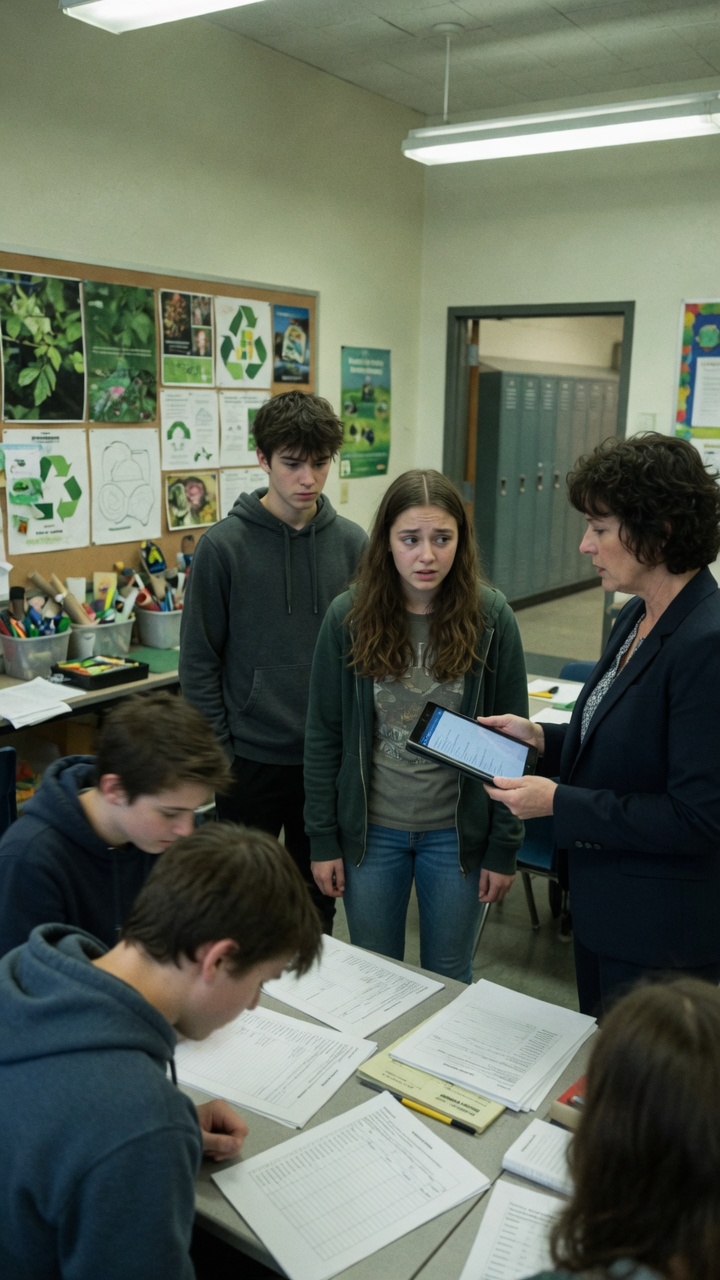
This school poster truth begins inside an ordinary high school environmental club in Eugene, Oregon, where everyone expected another routine afternoon of preparing displays for an upcoming sustainability event. Instead, the room felt unusually quiet. Conversations stopped as soon as I stepped through the doorway, and dozens of eyes settled on me with expressions that already seemed convinced of something I didn’t understand. A large campaign poster lay damaged across one of the tables, its torn edges and smeared colors becoming the center of attention. Before I could even ask what had happened, I realized that someone had already decided I was responsible. What followed became one of the most important lessons I would ever learn about assumptions, reputation, and why facts matter more than confidence.
Part 1: When Blame Arrived Before the Truth
The environmental club had always been one of my favorite places in school. Students worked together on recycling drives, community cleanups, and awareness campaigns that brought positive energy to campus.
That afternoon felt completely different.
Victoria Langford stood beside the damaged poster surrounded by several classmates. She looked calm, almost too calm, as if she already knew exactly how the conversation would unfold.
«I didn’t think anyone would actually destroy it,» she said quietly.
Several students immediately looked toward me.
I blinked in confusion.
«Destroy what?»
No one answered directly.
Instead, another student explained that I had been one of the last people in the room the previous afternoon.
Within moments, the assumption had become accepted as fact.
People whispered.
Others avoided eye contact.
A few classmates suggested I should no longer participate in the project.
The most surprising part wasn’t the accusation itself.
It was how prepared everyone already seemed to be.
I remembered something unusual from earlier that morning. While checking club supplies, I had requested access records because I couldn’t understand the timeline surrounding the damaged display.
Those records were sitting inside my backpack.
I calmly placed several printed pages onto the table.
«Can everyone look at these first?» I asked.
The room became noticeably quieter.
The papers showed electronic door access records with exact timestamps.
Victoria crossed her arms.
«Those don’t prove anything.»
«Maybe they do,» I replied.
Several students leaned closer.
One quietly pointed toward a series of matching timestamps.
Another frowned after comparing the entries.
Suddenly the confident atmosphere surrounding the accusations began to change.
Just then, the assistant principal entered carrying a tablet.
Behind her came another staff member holding a folder.
Neither person appeared emotional.
They simply looked prepared.
The room fell completely silent as everyone waited to hear what the official records would reveal.
school poster truth story moment
Part 2: The Records Everyone Needed to See
The assistant principal placed the tablet beside the printed access logs and calmly displayed the school’s electronic records.
Every timestamp matched the pages already lying on the table.
The information showed exactly when students had entered and exited the club room.
It also confirmed that the timeline many people had accepted earlier simply wasn’t accurate.
Victoria tried to explain that she had returned later because she had forgotten something.
The faculty advisor listened respectfully before opening the folder she had carried into the room.
Inside were maintenance reports completed the previous evening.
The school’s custodial supervisor had documented finding the damaged poster before classes even began that morning.
The report included photographs and written observations recorded during the normal inspection process.
There was no evidence connecting me to the damaged display.
Several students slowly lowered their heads.
Others admitted they had accepted the first explanation without asking questions.
One classmate quietly apologized.
Then another did the same.
The assistant principal reminded everyone that schools work best when students allow facts to guide difficult conversations.
She explained that protecting someone’s reputation should never come at the expense of another person’s.
The advisor suggested that instead of arguing about the damaged display, the club should work together to rebuild it.
No one objected.
Within minutes, students gathered fresh materials, printed replacement graphics, trimmed new borders, and carefully assembled an even stronger poster than before.
Victoria eventually walked toward me.
She apologized sincerely, admitting she had focused too much on protecting her own image instead of waiting for the complete story.
I accepted her apology because continuing the conflict would not repair what had already happened.
As the finished display was carried into the hallway, the atmosphere inside the club felt completely different.
The project had been restored, but something even more valuable had also returned.
Trust.
Everyone left the room with a better understanding that assumptions can spread quickly, while truth sometimes requires patience, evidence, and the willingness to listen before reaching conclusions.
The experience reminded every student that fairness is built one honest decision at a time, and that lasting respect always begins with giving people the opportunity to be heard.
If this story encouraged you to value evidence, fairness, and understanding before judgment, consider sharing it with someone who believes the truth deserves a chance to be heard.
Unlock Rest of Content
To view the final sentences, click below to verify you are a human reader.
Echoes of Love contributor covering news and analysis with editor review before publication.
Family Secrets, Moral Dilemmas, Relationship Dramas · Over a decade of experience in creative writing, editing emotional human-interest stories, and managing independent media publications.