
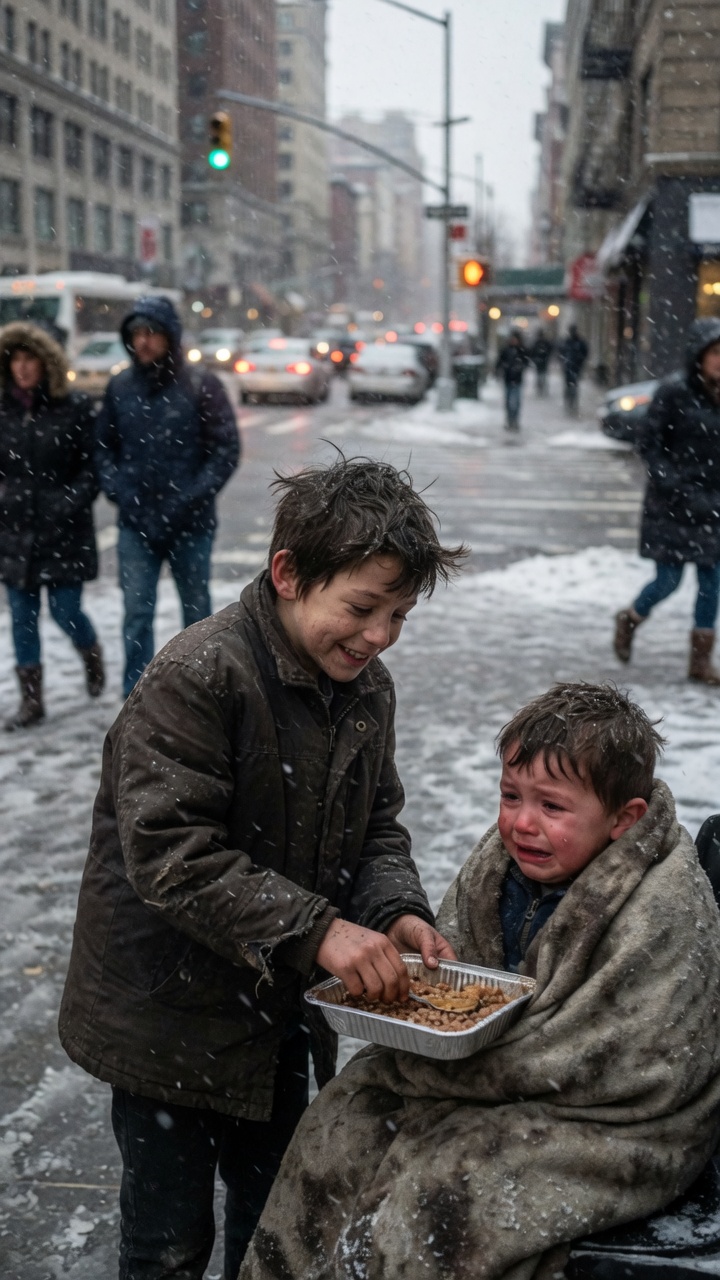

This Winter Kindness begins on a gray afternoon in the middle of a crowded American city, where the wind cut through every heavy coat and turned the sidewalks into a place people crossed quickly instead of looking closely. At one busy intersection, a ten-year-old boy sat on the frozen pavement with a small meal tray balanced in his hands. Beside him, a toddler no older than three trembled under a thin blanket, his face streaked with tears and his tiny body curled inward against the cold. The older boy had not eaten enough in days, yet he kept staring at the child beside him with the kind of focus that came from love, fear, and responsibility all mixed together. When the little one cried out from hunger, the older boy did not protect the food from him. He lifted the tray, set it gently into the toddler’s lap, and made a choice that no one walking past would ever forget.
Part 1: Winter Kindness on a Frozen Street
The older boy’s jacket was worn thin at the elbows, and his sneakers had soaked through long before the snow began to fall. He looked like he had grown up too quickly, the way children sometimes do when hunger becomes part of the day and not just a passing problem. The toddler beside him kept sniffing and crying in short, broken breaths, trying to understand why the cold hurt so much and why his stomach would not stop twisting. The tray held only a simple meal, the kind of food most people would have eaten without thinking. To the boys, it looked like a miracle. The older boy gave it away anyway. “You eat,” he said softly, his voice steady even though his own hands were shaking.
The toddler stared at the food as if he could not trust what he was seeing. Then he whispered that he had not eaten, and those words seemed to land harder than the wind. The older boy looked down, because he knew that kind of hunger. He knew what it felt like to count the hours between scraps, to wonder whether the next meal would come from kindness, luck, or nothing at all. Around them, people kept moving. A man in a black business coat stepped around them without slowing. A mother pulled her child closer and hurried across the crosswalk. Two teenagers glanced over, then looked away. The city was full of motion, but none of it belonged to the boys sitting on the pavement.
The little one tore off a tiny piece of bread and pushed it back toward the older boy, still sobbing. The older boy shook his head and forced a small smile that did not hide how tired he was. He told the child to finish eating. He tucked the blanket tighter around the toddler’s shoulders and rubbed his own arms to keep warm. Snow gathered in his hair and melted against his skin. The air smelled like exhaust, wet concrete, and winter. For a long minute, neither boy spoke. They simply sat there, sharing one meal and one patch of warmth, while the rest of the intersection kept rushing by as if two children did not matter.
Then the older boy lifted his face toward the sky and whispered, “Please.” It was not the kind of plea adults make when they are angry or demanding. It was smaller than that. It sounded like a child asking the world not to forget him entirely. Across the street, a woman sitting behind the wheel of an SUV stopped watching traffic and looked toward the boys instead. She had been there long enough to see the older child give away the food and the younger one try to give it back. She saw the way the older boy kept glancing at the toddler first and his own hunger second. What she did next would pull that freezing afternoon into a completely different future.
Part 2: When Winter Kindness Finally Found a Home
The woman got out of her vehicle carrying two hot meals, a thermos of soup, gloves, and a pair of thick knit hats she kept in the back seat for days exactly like this one. When she crossed the street, the older boy stood up at once and stepped slightly in front of the toddler, a protective habit so natural it seemed built into his bones. He looked ready to apologize for existing. The woman knelt down so they would not have to look up at her. She told them she was not there to take anything away. She was there because she had seen what the older boy had done.
At first, the boys did not know what to make of her. Children who have been ignored long enough do not trust kindness immediately. They wait for the catch. The woman learned their names slowly, speaking with the kind of patience that made it easier for them to answer. The older boy’s name was Eli, and the toddler’s name was Jonah. She asked where their parents were, and Eli looked toward the street before saying the words he had probably been carrying for weeks. Their mother had been gone after an illness, their father had vanished long before that, and they had been moving from one temporary place to another until there was no place left at all. They had been sleeping in doorways, on buses, and sometimes under an awning behind a closed store when no one chased them away.
The woman called emergency child services from her phone, but she did not leave. She stayed beside the boys while officers arrived, and she insisted on speaking first so that no one treated them like trouble instead of children. By then, Eli had started feeding Jonah small bites of the warm meal with careful, steady hands. The toddler’s crying had quieted, replaced by the exhausted relief that comes when a frightened child finally feels safe enough to breathe. The responding officers brought blankets and helped the boys into a heated vehicle. A doctor checked Jonah for dehydration and frostbite at a nearby clinic, while Eli sat in a chair too wide for his thin frame and kept asking whether his little brother would be okay. For the first time in a very long time, someone answered his questions instead of walking past them.