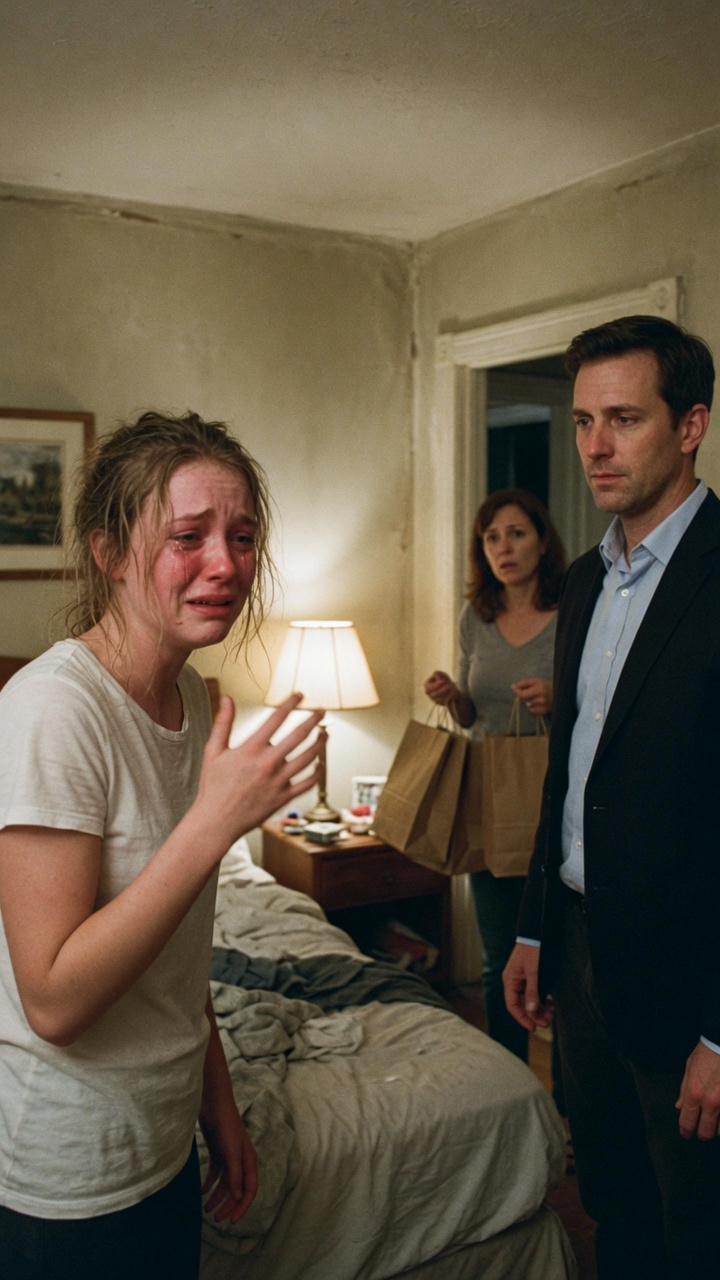
This family betrayal begins in a bedroom where a young woman has finally reached the edge of what she can carry. She is nineteen, exhausted, and shaking so hard that her own hands barely feel like they belong to her. For months she has watched a man she was supposed to trust smile at her mother, speak softly in the kitchen, and act like the stable center of the home while quietly turning every conversation into something dangerous. Tonight, everything has come to a head. She is crying, furious, scared, and determined to tell the truth even if it destroys the peace of the house forever. What she does not know yet is that the lie waiting in the room is already prepared, already polished, and already aimed directly at her. This family betrayal is not loud at first. It is controlled. It is patient. And that is exactly why it is so hard to stop.
Part 1: The Lie That Spoke First
The argument had been building for a long time before the girl ever opened her mouth. She stood near the bed, breathing unevenly, trying to keep herself steady while the man across from her watched her with a calm expression that felt almost rehearsed. He was thirty, well dressed, always careful, and always able to make himself look reasonable. To anyone else, he seemed like the kind of man a mother would be relieved to bring home. To her, he was the center of a family betrayal she had been trying to survive in silence.
“I can’t do this anymore,” she said, her voice breaking as tears spilled down her face. “I’m going to tell her everything.”
The words should have brought panic. Instead, they brought calculation. He did not raise his voice. He did not deny anything immediately. He only shifted his weight and looked at her as if he already knew what she was about to do. That made her stomach twist harder. People like him did not win by losing control. They won by staying composed long enough for everyone else to doubt their own instincts.
When she said she was going to the police, his expression changed just enough to make the threat feel real. “Think carefully before you do that,” he said, quiet and measured. She laughed bitterly through her tears, because he always spoke like that, as if every warning was a favor. But this time she pointed toward the hallway and said she was done. She was ready to leave the room, ready to speak, ready to stop letting this family betrayal rot the house from the inside out.
That was when he stepped closer and lowered his voice. “Your mother will never forgive you.”
Those words landed harder than the fear of exposure, harder than the fear of being blamed, harder even than the fear of what people might say if they found out. Because he knew the one wound that could make her freeze. He knew that losing her mother would hurt more than losing everything else. He saw the hesitation in her face and immediately pressed into it. “You think she’s going to choose you?” he asked. “She loves me.”
The girl’s throat tightened. She wanted to scream. She wanted to run. She wanted to rip away the version of events he was already building in the air between them. But before she could answer, the bedroom door swung open and her mother appeared in the doorway, holding shopping bags and staring at both of them with confusion. The girl rushed forward, desperate for a chance to explain, but the boyfriend moved first.
He stepped back slowly, letting his shoulders slump as if he was the one who had been cornered. Then he looked down and said, almost sadly, “I didn’t want you finding out like this.”
Her mother frowned. “Finding out what?”
He waited a beat too long, then answered with perfect timing. “I’ve been trying to handle it privately.”
The girl knew immediately what was happening. This was not improvisation. This was the heart of the family betrayal: he had already decided how the story would sound before her mother ever entered the room. And then he said the sentence that made the girl feel the floor drop away beneath her.
“Your daughter thinks she’s in love with me.”
Silence hit the room so fast it felt physical.
The mother stared at her daughter in shock. The girl could barely breathe. “What? No, Mom, he’s lying!” she cried. “He’s making this up!” But every time she raised her voice, she sounded emotional. Every time he spoke, he sounded careful. That difference mattered more than anyone wanted to admit. It gave him the upper hand. It gave his lie shape. It gave his lie weight.
He kept going, telling her mother that he had tried to reject her gently, that he had tried to protect her from embarrassment, that he had deleted messages because he did not want to humiliate anyone. The girl stared at him in disbelief. He had answers ready for everything. He had turned the family betrayal into a performance where he was the injured adult and she was the unstable child. Her mother looked between them and, even if only for a second, doubt entered her face. That was enough. Doubt was poison. Once it got in, it spread.
Over the next several days, the house changed. Her mother stopped knocking before entering the room. She stopped sitting beside her at dinner. She stopped asking questions that used to sound ordinary and now sounded impossible to answer. The boyfriend, meanwhile, remained perfectly helpful. He carried himself like the same steady man he had always pretended to be. He made coffee. He offered to help. He spoke gently. He acted wounded. Every detail of his behavior was designed to make the family betrayal look like a misunderstanding instead of a warning.
Then, one evening in the kitchen, the girl heard them talking when they thought she was elsewhere. Her mother whispered that maybe the girl was jealous. The boyfriend sighed with practiced sympathy and said he did not blame her. He even suggested that being raised alone might make her feel replaced. That was the moment the girl understood that the story had already begun to harden in her mother’s mind. She was losing not because the truth was weak, but because he had been allowed to speak first.
Part 2: The Truth That Would Not Stay Buried
After that night, the girl stopped pleading and started gathering proof. The fear inside her did not disappear, but it changed shape. It became focus. She backed up messages, recovered screenshots, saved call logs, and pieced together every detail she could prove. She knew that in a family betrayal like this, emotion would not be enough. She would need something solid enough to survive his calm voice.
For days she moved through the house like a ghost. Her mother remained distant, not cruel, just uncertain in the way that uncertainty can feel crueler than anger. The boyfriend continued to play the role of the stable one. He offered to fix small things around the house. He checked on her mother. He made sure he was seen as patient and concerned. He acted like a man suffering under unfair suspicion, and every act made the false story feel more believable from the outside.
Then came the night when the girl laid everything on the kitchen table.
Her mother sat down and began reading. At first she said nothing. Then she read more slowly. Then again. The messages were not vague, and they were not open to interpretation. They showed exactly how often he had manipulated the situation, how carefully he had positioned himself, and how deliberately he had tried to isolate the daughter by making her look unstable. The color drained from her mother’s face. The certainty she had clung to began to collapse in real time.
The boyfriend tried once to speak, but this time his voice did not carry the same power. The proof had already entered the room. It had already defeated the tone of his voice. It had already stripped the family betrayal down to what it really was: a deliberate lie built to protect himself and punish the girl for speaking up.
Her mother looked up slowly. “I should have listened to you,” she said.
The girl had waited so long to hear those words that they almost did not feel real. She sat there stunned, exhausted, and shaking in a completely different way than she had the first night. Her mother’s apology was not enough to erase what happened, but it broke the final wall between them. For the first time, the girl was no longer fighting alone inside a story someone else had written about her.
The police were called. The boyfriend’s calm act finally failed under the weight of documented truth, and the polished image he had built began to collapse. Neighbors who once saw only charm now saw exactly how false that charm had been. The house felt different after he left. Not healed. Not instantly safe. But no longer trapped inside his version of events.
In the weeks that followed, the mother admitted how badly she had wanted to believe the wrong person. She admitted that she let his composure speak louder than her daughter’s fear. She admitted that this family betrayal had worked because manipulation often sounds gentle when it first enters a home. The daughter listened, not because the pain was gone, but because the truth had finally been named.
Eventually, the house grew quieter in a healthier way. The girl slept without dread pressing against the walls. Her mother started to rebuild trust the only honest way possible: slowly, openly, and without excuses. The betrayal did not vanish from memory, but it stopped controlling the room. And sometimes that is what survival looks like after a lie has ruled too long. It looks like the truth surviving the silence, one honest conversation at a time.
In the end, the girl did not need to win an argument. She only needed the truth to be heard before the lie could become permanent.