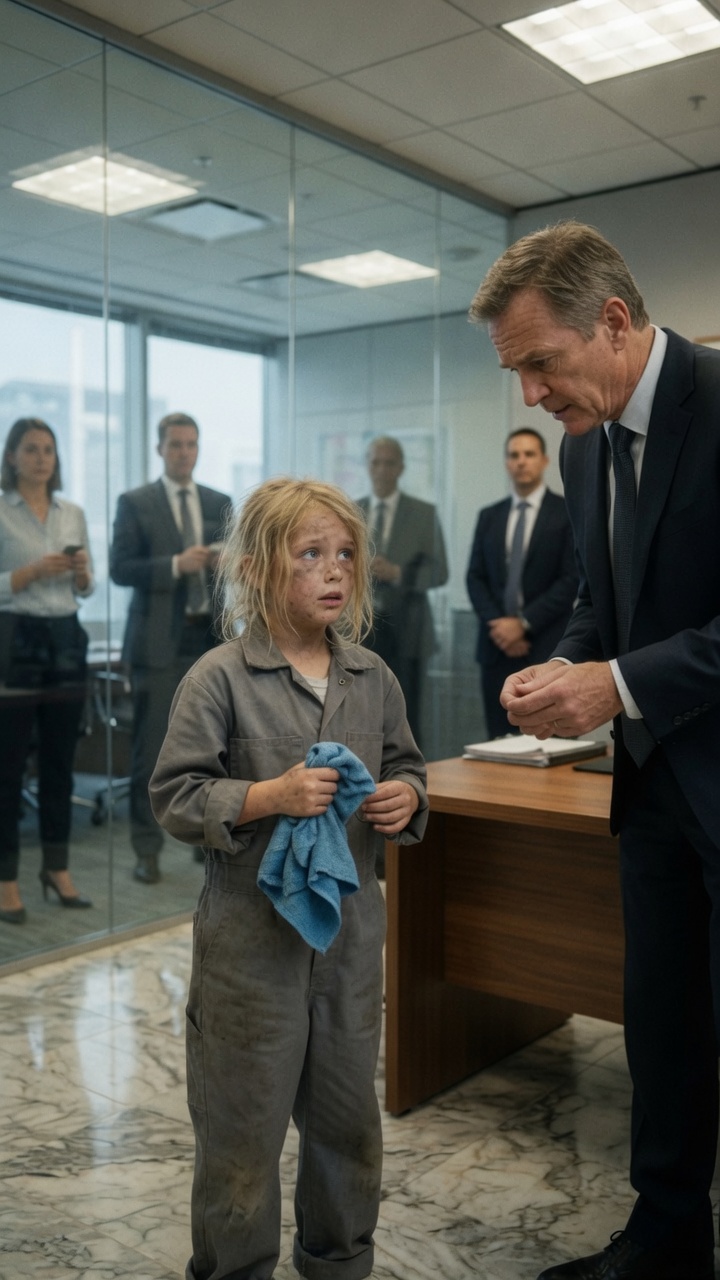

This Mother’s Access Card begins in a glass-walled office where power looked polished from the outside and fragile from the inside. A little girl stood near a sleek wooden desk, gripping a blue cloth with both hands as if it were the only thing keeping her steady. Her gray jumpsuit hung too large on her thin frame, and her blonde hair fell in uneven strands around a face marked by dirt and fear. Across from her, a CEO in a dark suit looked stunned by her presence, not because she had entered his office, but because she had entered it carrying a kind of truth that could not be ignored. Everyone in the room sensed that something was wrong, yet no one understood how deep the problem ran. The girl did not look lost. She looked instructed. She looked like a child who had been told to finish a task even when the world around her had turned upside down. That is how the story of Mother’s Access Card started: with a child, a secret, and a man who was about to learn that the smallest hand in the room could hold the heaviest message.
Part 1: Mother’s Access Card in the Glass Office
The office sat high above the city, bright and quiet, with glass walls that made every movement visible. Employees pretended to work while they watched the scene unfold. A woman near the far wall lowered her eyes. A man by the conference table stopped mid-step. The security guard near the elevator stood too still, his expression flat in the way people look when they have already guessed that something is wrong and hope no one asks them to speak. The CEO had stepped out from behind his desk with the measured calm of someone used to being obeyed, but that calm disappeared the moment he noticed the child. She was small enough to vanish beside the polished furniture, yet she stood there with a strange, painful seriousness, as if she had been given a duty adults had failed to carry out.
“Excuse me, sir,” she said in a voice so quiet it almost sounded like a prayer. “I’m here to clean up the mess.”
The words startled him. He looked from the cloth in her hand to the spray bottle she clutched against her chest, then back to her face. “You’re a child. What are you doing here?”
She pointed toward the desk. “They took Mommy. I’ll start.”
Before anyone could stop her, she sprayed the surface and wiped it with careful, shaking motions. She scrubbed the wooden desk with the focus of someone who believed the work mattered more than the fear. There was something heartbreaking in the way she moved, because she was not playing at cleaning. She was trying to complete a responsibility she did not fully understand, using all the strength her small body had left. The CEO watched her for several seconds without speaking. Then he stepped forward and gently took the bottle from her hand.
“Where is your mother?” he asked.
The question changed everything. The air in the office seemed to tighten. The girl froze, blinking rapidly as if she were deciding whether it was safe to answer. One employee behind the glass looked down at the floor. The security guard shifted his weight from one foot to the other and glanced toward the hallway. The child reached into the front pocket of her oversized jumpsuit and pulled out a crumpled access card. The plastic was bent at the corner, and the edges had been worn soft by repeated handling.
“She said give this to the boss,” the girl whispered.
The CEO took the card. At first, it seemed ordinary, the kind of employee badge that opened doors and logged entries and exits. Then he turned it over and saw that a folded note had been taped to the back. He did not open it immediately. He simply stared at it, as if he understood that once he read the message, nothing about the room would remain the same. Around him, the employees had gone silent in a way that was almost unnatural. Nobody coughed. Nobody cleared a throat. Nobody reached for a phone. They all waited, and that waiting itself became its own confession.
Finally, the CEO unfolded the paper. The handwriting was small, rushed, and unmistakably human. It was not written by someone asking for attention. It was written by someone trying to survive long enough to be believed. The note said that if the child was standing in front of him, then the truth had already moved beyond the point of being hidden. The girl had not come alone. She had been sent. And if the message was real, then someone inside the company had done something terrible enough to make a mother risk everything to get one final note into the right hands.
The CEO looked up sharply, and for the first time the office saw something beneath his authority that he rarely showed in public: alarm. He asked for the security logs. He asked for the overnight cameras. He asked for the names of the people working the floor after midnight. The room that had once felt rich and controlled now felt exposed. The child stood in the middle of it all, still clutching the blue cloth, watching the adults scramble around a truth she had never asked to carry.