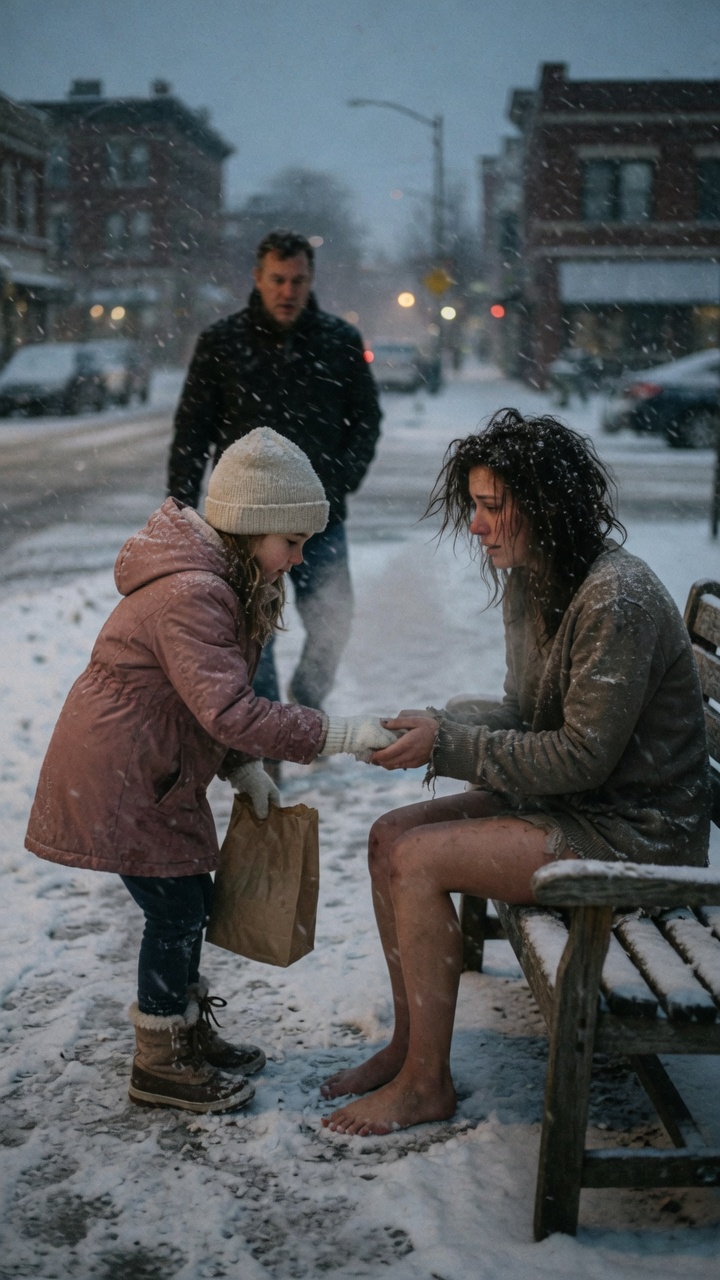
This Homeless Woman Story begins on a gray winter afternoon when snow drifted down the street in soft, steady flakes and turned the whole city into a blur of cold and silence. On a bench near the sidewalk sat a young woman with snow caught in her dark hair, her bare feet pressed into the frozen ground, her thin sweater doing almost nothing against the wind. She looked exhausted in the way only people who had been holding themselves together for too long could look exhausted. A little girl in a dusty-rose coat and cream knit beanie walked toward her holding a small brown paper bag with both hands, as if it held something fragile and important. A few yards behind her, a man followed with slow, careful steps, watching the scene with a guarded expression that suggested he already knew this moment mattered, even if he did not know why. No one on that street realized that one child’s gentle kindness was about to reach into a hidden wound and pull out a truth that had been buried for years.
Part 1: The Bench in the Snow
The little girl stopped in front of the bench and looked up at the woman with a seriousness far older than her six years. Her cheeks were pink from the cold, her gloved hands wrapped tightly around the bag, and her boots left tiny prints in the snow as she shifted her weight. The woman lifted her head slowly, as if even that small movement cost her energy. Her face held a tired beauty that the cold had not managed to erase, but her eyes were heavy with hunger and worry.
“Are you cold?” the child asked in a soft voice that seemed to belong more to the moment than to the street.
The woman tried to smile. It was the kind of smile people gave when they had learned not to expect anything from strangers anymore. “A little,” she said. “But I’m fine.”
The child looked at the paper bag, then back at the woman. “Daddy bought these for me,” she said. “But you look hungry.”
For a second, the woman just stared. Then her fingers trembled as she reached forward and accepted the bag. Their hands touched briefly, and something strange moved across her face, so fast it almost looked like pain. Her eyes narrowed in disbelief, then widened, as though a memory had struck somewhere deep inside her chest. The little girl did not pull away. She only watched her with a calm, sad trust that made the moment even more fragile.
The woman lowered her gaze to the bag, then back to the child. Snow settled on her shoulders and lashes while the sound of the city seemed to fade around them. The little girl took one tiny step closer, as if she had decided the world was safe enough for a secret. Then she said the words that stopped everything around them.
“You need a home… and I need a mom.”
The woman froze so completely that even her breathing seemed to stop. Her lips parted. Her hands tightened around the brown paper bag. Behind the girl, the man who had been watching from the sidewalk stopped moving too, his face draining of color as if he had just heard his own name spoken from a long distance. The child kept looking at the woman, her face open and honest in that disarming way only children could manage.
Then she added, almost in a whisper, “Mine went away when I was little.”
The woman’s eyes filled instantly. She looked down at the bag again, then back at the child, and her voice came out broken and thin. “What did you just say?”
The child opened her mouth as if she were about to answer, but the words did not come right away. Instead, she glanced over her shoulder toward the man behind her, and something in her expression shifted. It was not fear. It was recognition. The woman saw it too, and the color seemed to drain from her face all at once.
Homeless Woman Story: The Words That Stopped the Street
The man took one slow step forward. Then another. His boots crunched through the snow as he crossed the short distance to the bench. He looked at the woman with the stunned expression of someone who had spent years trying not to imagine this exact moment. The little girl turned between them, sensing the tension but not understanding the full shape of it.
“Daddy,” she said quietly, “that’s her.”
The woman’s mouth opened, but no sound came out. The man looked from the child to the woman, and then something in his face broke apart. Not in anger. In shock. In grief. In recognition that arrived too late to be gentle.
Years earlier, he and the woman had loved each other with the reckless certainty of people who believed love alone could hold a future together. They had argued, separated, and then been torn apart by lies that had been fed to both of them from different directions. He had been told she had left. She had been told he wanted nothing to do with her. By the time the truth should have come out, pride and fear had already built a wall between them. Then life became harder, and the woman disappeared into a season of loss that left her without shelter, without support, and without anyone who knew where she had gone.
But the little girl had found a photograph one day in a keepsake box hidden at home. She had studied the face in the picture for a long time, asking questions in the simple, direct way children do. Her father had gone quiet when she held the photo up and asked who the woman was. He had not expected her to remember the face. He had not expected anything at all, really. Yet when she saw the woman sitting on the bench in the snow, she recognized the same eyes from the photograph immediately.
That was why she had walked over without hesitation. That was why the bag mattered less than the face behind it. That was why her voice carried a confidence that sounded almost impossible for a child so young. She had not come to offer pity. She had come because some part of her heart had already decided this stranger could not be a stranger for long.
The father finally spoke, and his voice shook on the first word. “I thought I lost you.”
The woman stared at him through tears that had already begun to fall. “I thought you left,” she whispered back. “I thought you chose to disappear.”
Snow kept falling between them, soft and relentless, as if it were covering the entire street in the kind of silence people only feel right before they tell the truth. The child looked from one adult to the other, then reached out and took both of their hands. Neither one pulled away.
Part 2: The Truth Under the Snow
The woman’s hand trembled in the man’s grip. He had been carrying years of guilt without knowing the shape of it, and now he could feel it all at once, sharp and undeniable. He told her, in fragments at first, about the messages she had never received, the lie that had been repeated until it seemed real, the distance that had grown because neither of them had the full story. She listened without interrupting, tears slipping down her cheeks as the frozen afternoon became the setting for a truth she had almost stopped believing could still belong to her.
She told him what happened after she lost the apartment, after the people she trusted stopped calling, after each small setback turned into a larger fall. She had done what she could to stay afloat, but the world had not been kind. By the time she realized how far she had drifted, she no longer knew how to step back into the life she had left behind. Shame had kept her silent. Fear had kept her moving. Hunger had kept her focused on survival instead of answers.
The little girl stood between them, still holding the emptying paper bag, and looked from one face to the other as if she were watching two pieces of a puzzle finally fit together. Then she said, “So she really is my mom?”
That question shattered whatever was left of the adults’ composure. The father let out a shaky breath and knelt slightly so he could meet his daughter’s eyes. “Yes,” he said softly. “She is.”
The woman covered her mouth with one hand and cried openly now, not from pain alone, but from the unbearable relief of hearing a truth she had already loved once but thought she had lost forever. The child stepped forward and wrapped her small arms around the woman’s neck. The woman held her carefully, as if she were afraid too much pressure might break the miracle in front of her. The father joined them a moment later, his hand resting on the child’s back, his shoulders shaking with the weight of all the years that had passed in the dark.
People on the street had slowed to a stop. Some watched from the warmth of store windows. Others lowered their heads and kept walking, but even they seemed to sense that something private and holy was taking place on that bench in the snow. The woman was not healed all at once. The father did not erase the past by standing there. The little girl did not solve everything simply by being brave. But the family that had been scattered by lies had finally found each other again, and that mattered more than the cold, more than the fear, more than the years that had been wasted apart.
In the days that followed, the man found a place for her to stay. He helped her replace what life had taken, one practical step at a time. There were difficult conversations, painful apologies, and long pauses where nobody knew exactly how to speak without reopening old wounds. Yet every day brought one more piece of trust back into place. The little girl made sure there was always an extra place at the table. The woman learned how to sleep indoors again without listening for trouble in the night. The father learned that love does not always arrive in the shape you expect, but it can still return wearing the face of a child who refuses to let go.
By the time the first real warmth of spring reached the city, the three of them no longer looked like strangers standing near each other by habit. They looked like a family rebuilding itself with patience, honesty, and a kind of tenderness that had survived the worst weather life could throw at them. The brown paper bag was long gone, but the moment it represented stayed with them because it had begun with simple kindness and ended with a home coming back to life.
Sometimes the smallest act of compassion opens the door to a second chance, and sometimes a child is the one brave enough to knock.