This diner kindness begins the way most profound things do — quietly, without announcement, in a place that looks like nothing special from the outside. Arthur Meyers had run the same corner diner for over thirty years. The sign out front flickered when the wind picked up. The vinyl booths had long since worn thin in the center. The coffee was strong, the food was honest, and the hours were long. Arthur had made a life out of small, decent acts — a refill without being asked, a meal kept warm for a regular who came in late, a kind word offered to anyone who looked like they needed one. He did not think of these things as extraordinary. He thought of them as the minimum. On a rainy Thursday morning, he was about to discover that someone else had been counting every single one.
Part 1: A Stranger and an Act of Diner Kindness
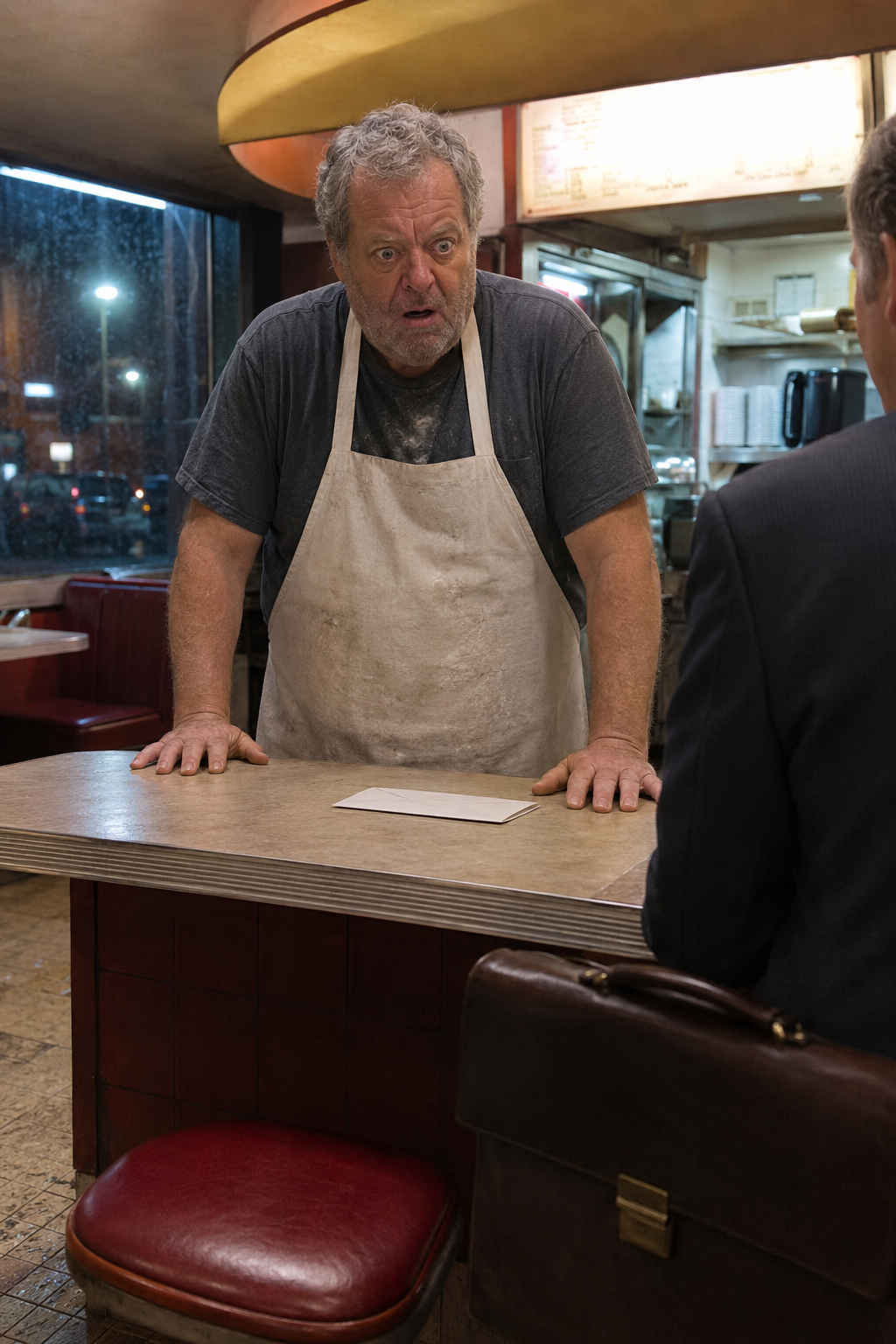
The man who walked through the door that morning did not look like anyone Arthur had ever served. He wore a charcoal suit without a wrinkle and carried a leather briefcase with the quiet, settled confidence of someone who had long since stopped having to prove anything. He sat down at the counter, slid a set of car keys across the worn laminate surface, and looked Arthur in the eye.
«Those are for you,» he said.
Arthur looked at the keys. Then he looked at the man. He pushed them gently back.
«I think you’ve got the wrong place.»
The stranger shook his head slowly. «No, sir. This is exactly the right place.»
Arthur frowned. «Do we know each other?»
The man didn’t answer right away. He glanced toward a booth near the window — the corner one, where the light came in sideways even on overcast days.
«Many years ago, a little boy sat right there for almost an hour,» he said quietly. «He read the menu over and over. He never ordered. He didn’t have any money.»
Something stirred deep in Arthur’s chest.
«When he finally left,» the stranger continued, «he walked around to the back of the building. He was eight years old. He hadn’t eaten since the morning before. He started searching through the trash.»
The diner went completely still. Even the rain against the front window seemed to pull back.
«Who are you?» Arthur asked.
The man reached into his briefcase and set a thick white envelope on the counter between them — placed it down carefully, like something that had waited a long time for exactly this surface.
«Someone who has owed you a thank-you for twenty years.»
And then Arthur remembered.
The small boy at the corner booth, eyes moving slowly over the menu prices with the patience of someone stretching out the warmth. Going out back to empty a bin and finding the child crouched behind the building, both hands searching, shoulders trembling inside a jacket too thin for the weather. Sitting down beside him on the cold pavement without a word of explanation. Carrying out two full plates of food and setting them down as if it were the most ordinary thing in the world.
He hadn’t thought about that afternoon since the day it happened. He had not attached any label to it at the time. It was just diner kindness — the kind of quiet act you do because the alternative feels wrong — and then he had gone back inside, back to the counter, back to the long ordinary business of keeping a diner running.
But someone else had not moved on.
Arthur’s hands began to tremble the moment he read what was written on the front of the envelope.
Part 2: The Envelope and the End of a Long Wait
What Twenty Years of Diner Kindness Built
The man’s name was Daniel Reeves. Arthur would learn this from the letter folded neatly inside — three pages of small, careful handwriting that told the full story of a boy who had grown up cycling through foster placements that never quite became homes. At eight years old, Daniel had run from a situation that had grown unsafe and walked for hours until he found himself standing outside a diner with a flickering sign. He had gone inside because it was warm. He had sat in the corner booth because no one asked him to leave. He had read the menu because it gave his eyes somewhere to go. And when he finally stepped back outside into the cold and went around to the back of the building and started searching through the trash, a man in a flour-dusted apron had come outside, sat down beside him on the pavement, and set two full plates of food in front of him as if it were the most natural thing in the world.
Daniel wrote that he had returned to that single act of diner kindness every time his life had pushed him close to an edge he wasn’t sure he could come back from. It had become evidence — real and specific evidence — that the world was capable of choosing generosity when it had no obligation to. He had worked through school entirely on his own. He had built a small technology company from the ground up. And the first meaningful thing he did when he had real money was hire someone to track down the diner. It had taken two full years to find it.
Arthur set the letter down on the counter.
His eyes moved to the cashier’s check beneath it.
The number made him press both hands flat against the surface just to keep himself steady.
It was enough to retire every debt the diner carried. Enough to fix the roof, replace the kitchen equipment, and finally repair the sign out front. Enough left over that for the first time in years, Arthur could breathe without calculating what that breath was costing him.
He raised his eyes from the check.
Daniel was watching him from across the counter with an expression that had nothing hidden in it — twenty years of carrying something, finally set down in the right place.
«You didn’t owe me a thing,» Arthur said. His voice barely held its shape.
«No,» Daniel said quietly. «But I wanted to.»
Arthur came around from behind the counter. He pulled Daniel into a hug the way you hold someone you hadn’t known you were waiting to see — with both arms and all the quiet weight of everything that had lived between that afternoon and this one. Daniel held on just as firmly.
Outside, rain still fell on the corner where the sign flickered. Inside the diner, something that had been waiting a very long time finally came to rest.
This is what diner kindness can grow into — not just a meal offered to a hungry child, but a foundation someone quietly builds an entire life on and eventually brings back. If this story moved you, share it with someone who still believes that small acts of decency matter. They do, far more than any of us will ever fully know.