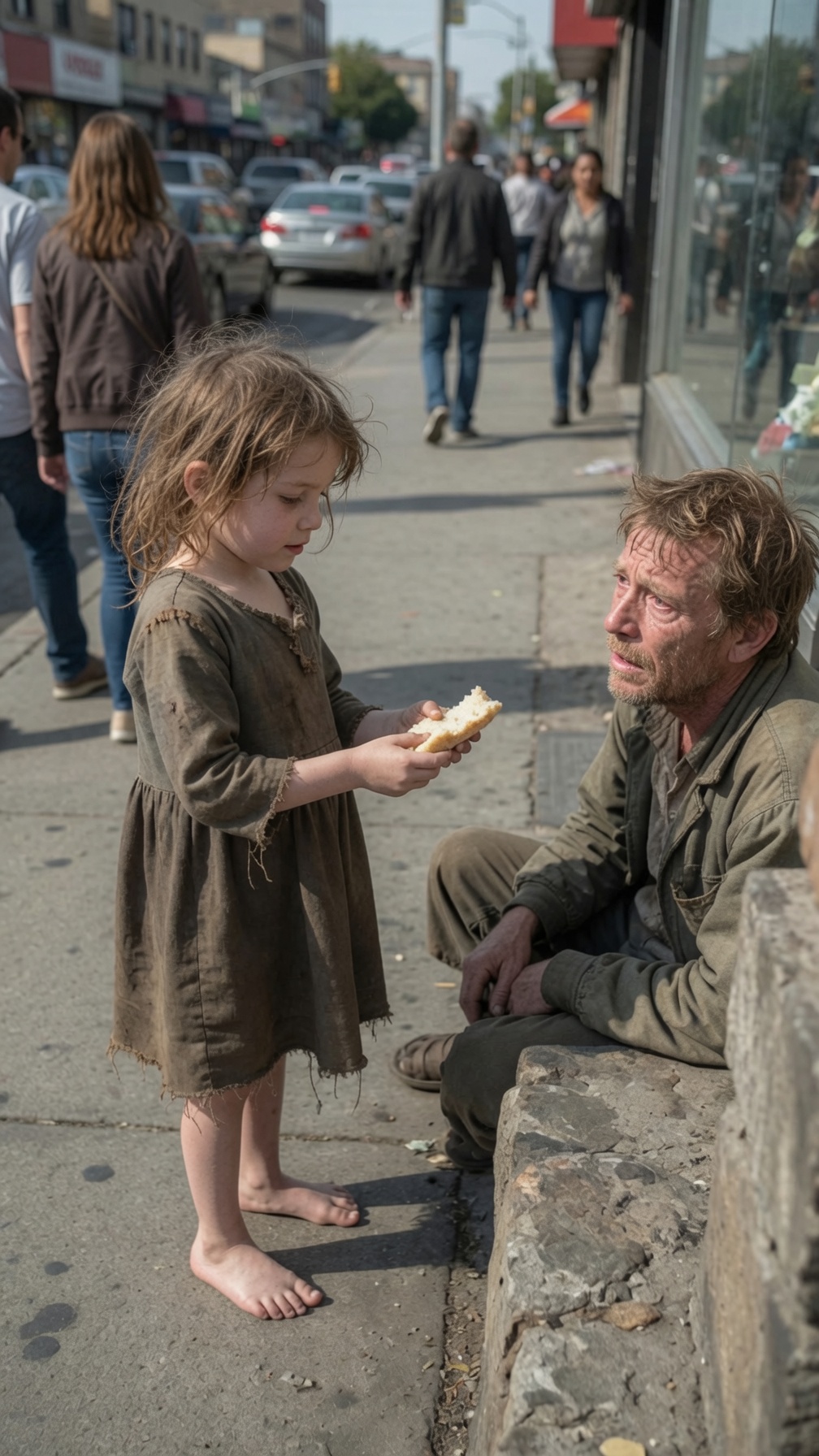
This barefoot girl begins on a crowded American city sidewalk where most people are too busy to notice the man sitting alone on a stone ledge, but one small act of kindness stops the noise long enough for the truth to surface. Cars crawl past in the heat, pedestrians glance at their phones, and an exhausted stranger hides his face in his hands while a barefoot child with a torn dress and dust on her feet walks toward him holding the last piece of bread she has. She is brave enough to ask a question that cuts through grief, surprise, and memory. What starts as a simple exchange of food quickly turns into a moment that no one on that street could have predicted.
Part 1: The Barefoot Girl and the Stranger
The afternoon had the usual city noise. Traffic backed up at the light, delivery trucks rumbled by, and strangers moved around one another with the practiced hurry of people who had learned not to look too closely at pain. On the edge of that motion sat a man who looked as if the whole day had already defeated him. His shoulders were hunched. His eyes were swollen and red.
He was not begging. He was simply sitting there, trying to gather himself while the sidewalk kept moving around him. Most people saw only a tired man in a worn jacket. None of them knew that he had spent the morning trying to hold together a life that had already cracked in places he never discussed.
That was when the barefoot girl appeared in front of him.
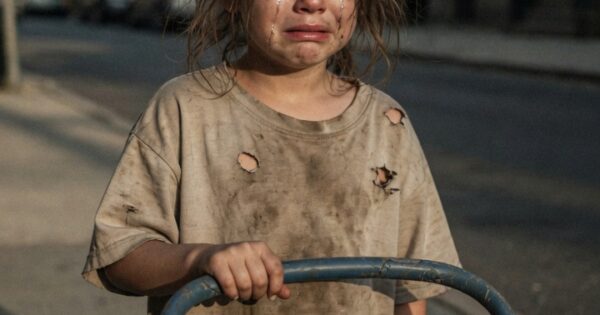
She was small and thin, with a faded brown dress hanging loosely from her shoulders and bare feet marked by dust and little cuts from walking too far on hot pavement. In one hand she held a piece of dry bread wrapped in a crumpled napkin. When he lifted his head, the first thing he saw was her expression, which held the careful seriousness of a child who had decided to do something important.
“Are you hungry too?” she asked softly.
The man stared at her in silence. He looked at the bread, then at her bare feet, then back at the bread again. It was obvious that the small piece of food meant a great deal to her.
He tried to smile. “No, sweetheart,” he said, his voice rough. “You keep that.”
She did not move. The barefoot girl only looked at him with a steady, concerned expression that made him feel more exposed than he wanted to be. A woman crossed the street without glancing over. A bus hissed at the curb. Yet the space between the man and the child felt suddenly quieter than the rest of the block.
Then she asked, “Then why are you crying?”
He had no answer ready for that. The question was too honest, too small, and somehow much larger than anything he had expected to hear that day. He looked back at her face, and something in her features stirred a memory he had kept buried for years.
She stepped closer and slowly broke the bread into two uneven pieces. One half stayed in her palm. The other she pressed gently into his hand. Their fingers touched, and the contact struck him with a force that made his whole body go still. It was familiar. It was impossible.
He stared at her face with growing shock, studying the shape of her eyes, the curve of her mouth, the tiny crease between her brows when she worried. Recognition, fear, and hope all appeared at once and collided so violently that for a second he could not move. Then he asked the question that changed the entire sidewalk.
“What did your mother say your name was?”
The girl blinked. She opened her mouth to answer, but before the words came out, the man’s face drained of color.
Part 2: The Truth Hidden in the Barefoot Girl
When the little girl finally said her name, the man closed his eyes for a moment as if the sound itself had hit him. He repeated it under his breath, because saying it aloud made the memory come back with painful clarity. He was no longer looking at a stranger. He was looking at a child who carried pieces of a life he had believed was gone forever.
His hands shook as he pushed himself to his feet. He did not move too fast. He asked who was with her that day. The girl turned and pointed down the sidewalk.
Across the street, a woman had stopped near a shop window. She had been watching them the entire time, and when the man looked up, she realized she had already been seen. Her face changed first to fear, then to disbelief. She knew him. That much was clear.
The man stared at her, and the rest of the street seemed to blur around the edges. Years of distance, silence, and unfinished grief pressed into one small moment. He understood, all at once, that the child in front of him was not simply a kind-hearted stranger. She was the reason his life had never quite settled.
The woman crossed the street slowly. She looked older than he remembered, more tired too, but the face was still unmistakable. When she reached them, she did not rush into an explanation. She only stood there with wet eyes and an expression that suggested she had been carrying this reunion in her chest for years. The barefoot girl looked from one adult to the other, uncertain now, but still holding the bread as if it were the most ordinary thing in the world.
Finally the woman said, “She has your eyes.”
That was enough to break the last of his restraint. He laughed once, but it sounded more like grief than joy. Then he knelt down beside the child on the sidewalk and told her, as gently as he could, that he was her father.
The barefoot girl stared at him in complete silence. The woman covered her mouth and began to cry openly. The child looked alarmed for a second, as children often do when adults break in front of them, but then the man placed a careful hand over hers and promised he would not leave again without telling her the truth.
He explained that he had been told a different version of the past, one that kept him away from his own child. He explained that he had searched in the wrong places and mourned a loss he thought was permanent. The woman listened without interrupting, because the most painful stories are often the ones that need silence more than they need correction.
The child listened too, though not to every detail. She was too young to understand all of it, but she understood enough. She understood that the man had tears in his eyes because he cared. She understood that the woman was not a stranger after all. And she understood, in the simplest way a child can, that her small piece of bread had somehow opened a door that adults had failed to open for years.
By the time the sun began to sink lower, the city had gone back to its usual rhythm. Cars still passed. People still walked by. No one crowded around them. The truth had not arrived with a crowd. It had arrived with a barefoot girl, a piece of bread, and a question that refused to be ignored.
He took her to a nearby store and bought the first pair of shoes that fit. She walked in them slowly at first, as if testing a new life step by step. Then she smiled, and that smile was so bright and sudden that he had to look away for a second because his eyes burned. The woman watched them both with a kind of exhausted relief that made the whole street feel quieter, softer, and more human.
Before nightfall, they sat together at a small diner and talked about ordinary things before they talked about the painful ones. That was how the day became real. Not through a speech, not through a miracle, but through the careful act of staying at the same table long enough to begin again.
The barefoot girl had not just shared her bread. She had shared the first moment of trust in a story that had been divided for years. And the stranger who sat crying on the sidewalk was no longer a stranger at all.
Some of the most important truths begin with the smallest kindness, and sometimes that is enough to bring a broken family back to the same street.